Conveyor and automation line frames at volume
By Ryan, independent sourcing agent, Ho Chi Minh City, Vietnam
Automation line frames are the most repetitive structures in the machine frame world. A line of conveyors, stations and robot cells may use dozens of near-identical frames, each of which must bolt to its neighbours and to the floor without drama. When the first frame is built it is a project. By the fiftieth it should be a routine, and the work of getting there starts long before the order is placed.
This article is about buying frames in volume from a partner shop. It covers design choices that make a frame cheap and consistent to build, how shops organise cutting, welding and finishing, which tolerances matter when units must interchange, and how to check quality when you cannot inspect every unit.
What changes at volume
In a one-off, cost is dominated by engineering time and flexibility. In a series, cost is dominated by repeatability. A shop invests in tooling, programs and a work sequence, and the saving per frame depends on how well that investment is used.
The steps that matter:
- Design for the process. Part count, joint count and the number of different sections have a direct effect on labour.
- Tooling. Fixtures, cutting programs and welding procedures are built once and reused.
- Process control. Samples, gauges and records catch drift before it becomes scrap.
- Logistics. Frames must be packed, labelled and shipped in a way that preserves geometry and identification.
Design for repeatable fabrication
Small design choices produce large differences in cost and consistency.
Use few section sizes. A frame made from three tube sizes needs three stock items and three cutting setups. A frame made from eight needs more of everything. Standardise on a short list and reuse it across frame families.
Cut with tab-and-slot features. Laser tube cutting can produce slots and tabs that locate parts to each other without a fixture. Parts snap together at the right position and need only tack welding. This reduces fit-up time and, because the cutter holds the tolerance, improves repeatability.
Reduce the joint count. Every weld joint costs time and adds distortion. Use bent plate instead of welded channel where possible. Combine small parts into one folded part.
Standardise hole patterns and interfaces. If every frame uses the same foot, the same top-plate pattern and the same bracket, the shop can fixture and gauge them once.
Choose weld sizes sensibly. Oversized welds add time and distortion. Fillet or full-penetration welds explains how to size joints.
Plan for finishing. A frame that powder coats well has no trapped pockets, drain holes where liquid could collect and enough hanging points for the coating line. Design for the hook, not just for the drawing.
Tooling by volume
| Volume per run | Typical shop approach | Notes |
|---|---|---|
| 1 to 5 | Manual fit-up on a flat table | Flexible, higher cost per frame |
| 5 to 30 | Modular fixture and jigs, manual welding | Good balance of cost and flexibility |
| 30 to 100 | Dedicated fixture, laser-cut parts, cobot or manual welding | Setup pays back within the run |
| 100 and above | Dedicated fixture with robotic welding and coating line | Needs stable design and tight part tolerances |
The range is typical, and the tipping points depend on frame size and complexity. The break-even logic is in welding fixtures for repeat production, and the choice of robotic or manual welding is in robotic or manual welding for small batches.
Learning effects
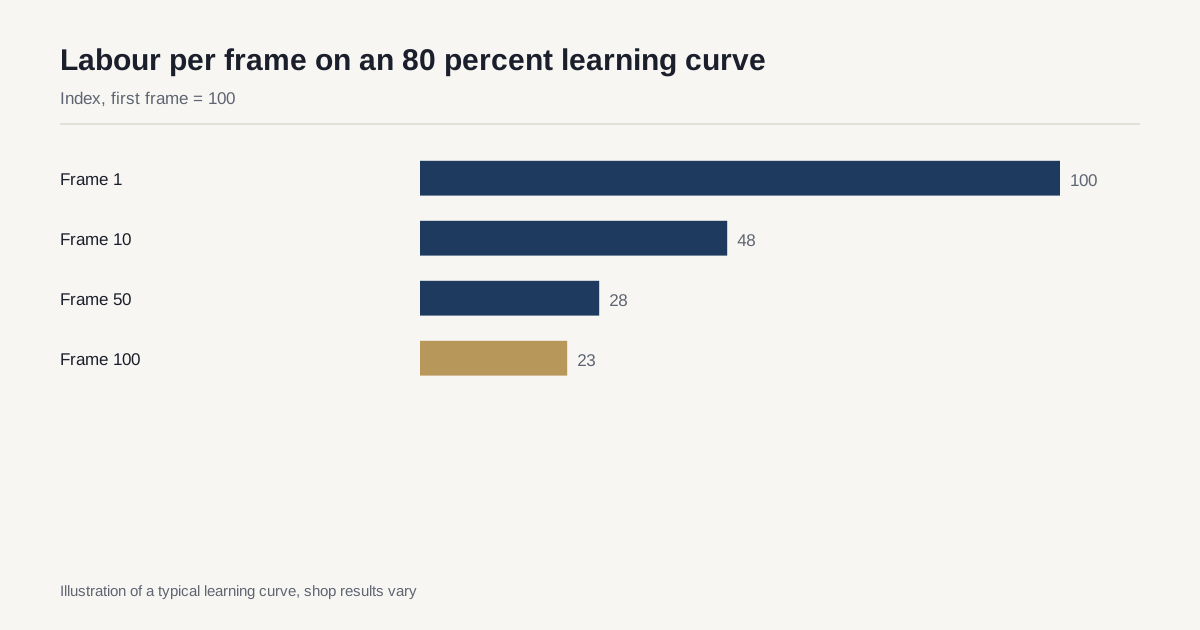
Repeated production gets faster. Industries describe this with a learning curve in which each doubling of cumulative output reduces unit labour by a fixed percentage. For an 80 percent curve, the labour for the tenth frame is about half that of the first, and the hundredth about a quarter. The effect is built from fixtures, better sequences, fewer mistakes and more confident welders.
That helps in two ways. A frame ordered in a longer series is cheaper per unit, and a shop that has built the frame before is faster on repeat orders. Ask for price breaks at several quantities, and consider whether a blanket order with scheduled releases suits your demand better than many small orders.
Tolerances for interchangeability
On an automation line, frames connect to each other and to the floor. A small error at each frame adds up along the line. Tolerances that matter:
- Interface hole positions. Holes that bolt one frame to the next need position tolerance relative to a datum, often ±0.5 mm for sheet-metal brackets and tighter if dowelled.
- Height and levelling. Conveyor frames set a running height. Adjustable feet cover floor variation, but the frame’s own height tolerance should leave enough adjustment range.
- Squareness and parallelism. Conveyor side rails need to be parallel along the length to keep belts and products tracking.
- Overall length. The sum of frame lengths sets the line length. Use a tolerance on each frame that the line layout can absorb.
For general tolerances on welded parts, ISO 13920 gives classes for linear and angular dimensions and for form. Name the class on the drawing and tighten only the features that need it. The method of combining errors is in machine frame tolerance stack-up.
Quality control with many units
You cannot measure everything on every frame, and you should not try. A practical approach is:
- First article. Full measurement and approval of the first unit, as in first article inspection for large weldments.
- Critical characteristics on every unit. A short list of features that affect interchangeability, such as interface hole positions and overall length, checked with a go/no-go gauge or a simple fixture.
- Full re-measurement at intervals. For example every tenth or twentieth frame, or after a fixture repair.
- Records. A simple traveller or log stating who built each frame, when and with which material heat. See mill certificate types.
A check fixture that mimics the mating frame is often cheaper and faster than a CMM for repeat checks.
Finishing and protection
Frames are usually powder coated or painted, with galvanising for harsher environments. Coating thickness, pretreatment and cure all affect appearance and durability, and they should be stated in the drawing or a coating specification. Machined interface surfaces are masked before coating, since paint on a mounting face changes geometry. For frames that ship overseas, see surface treatment for export frames.
Packing and logistics at volume
Frames ship in numbers. Pack in a way that avoids contact damage, supports the frame at its stiff points and identifies each unit.
- Stack with spacers and soft contact points.
- Label each frame with part number, revision and serial number.
- Keep loose hardware in a labelled bag attached to the frame.
- Specify container loading, as the number of frames per pallet changes freight cost. Shipping heavy weldments covers crating and Incoterms.
What to put in the RFQ
- Total annual volume, order size and release schedule.
- Whether the design is frozen and the planned revision cycle.
- Critical characteristics and the check method you expect.
- Coating specification and packaging requirement.
- Target price breaks at two or three quantities.
- Tooling ownership terms.
The structure in machine frame RFQ template helps cover these points.
Managing change on a running order
Long runs outlive their drawings. A bracket moves, a hole pattern changes, a customer asks for a different foot. Agree in advance how revisions are issued, when they take effect and how in-process stock is handled. A revision letter on the drawing, a cut-in serial number and a written list of affected frames keep both sides aligned. Ask the shop to quote the cost of a typical change, such as modifying a fixture pad, so that you can compare it with the benefit. A line that is stable for the first hundred frames and then changes without notice can produce a pile of parts that fit nothing.
Checklist
- Reduce section variety, joint count and part count before quoting.
- Ask for laser-cut self-locating features where parts can use them.
- Match tooling to volume and price setup separately.
- Define critical characteristics and a sampling plan for repeat units.
- Specify coating, masking and packing in detail.
- Request price breaks and consider a scheduled release agreement.
To compare how partner shops would build your frame at volume, send the drawing with annual quantities. The network replies within 24 business hours.
Have a frame drawing to price?
Send it through for a manufacturability review and a matched quote from the heavy-fabrication network. Reply within 24 business hours.