Welding fixtures for repeat machine frame production
By Ryan, independent sourcing agent, Ho Chi Minh City, Vietnam
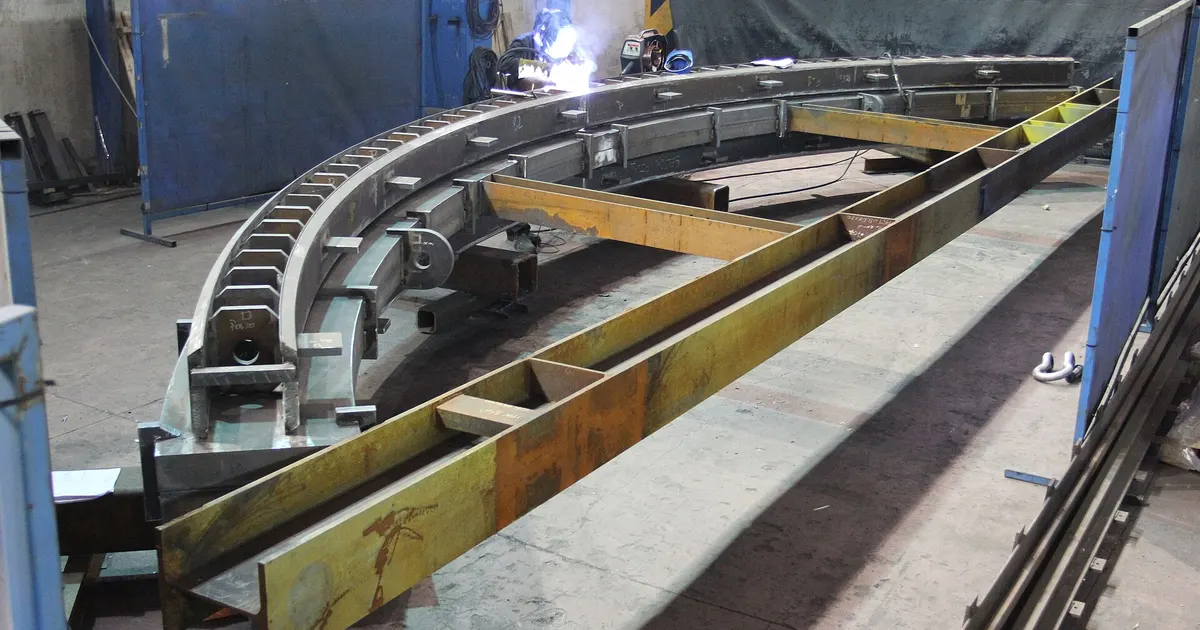
The first machine frame from a shop is usually the best one, because someone stood over it. The tenth is where the process shows what it is made of. If each unit is fitted by eye on a flat table, variation creeps in: a rib sits 2 mm over, a flange is a degree out, the weld shrinks differently each time. A fixture takes that variation out by making the geometry a property of the tool and not of the person.
This article looks at when a fixture is worth the money, what kinds exist for frame work, how accurate a fixture has to be and the commercial questions that cause arguments later: who pays, who owns it and what happens when the design changes.
What a fixture does
A welding fixture does four jobs.
Locates the parts. Pins, stops and datum surfaces put each piece where the drawing says it should be, so fit-up does not depend on measurement during assembly.
Holds them. Clamps resist the forces of tack welding and the pull of weld shrinkage. Restraint redirects shrinkage into residual stress instead of distortion. That stress is later reduced in stress relief. The balance between restraint and movement is discussed in controlling distortion on large weldments.
Gives access. A good fixture lets the welder, or robot, reach every joint, rotate the part to a convenient position and keep a consistent welding position from unit to unit.
Speeds up fit-up. The time saved is often larger than the welding time saved, and for repeat orders it is the main reason fixtures pay back.
Types of fixture for frame work
| Type | How it works | Best batch | Relative cost | Notes |
|---|---|---|---|---|
| Strongbacks and simple jigs | Bars and stops welded or bolted to a table | 2 to 10 | Low | Fast to build, limited accuracy |
| Modular welding table | Perforated or slotted table with standard clamps, stops, angle blocks | 5 to 50, mixed jobs | Medium, reusable | Accuracy limited by the table and stack-up of parts |
| Dedicated fixture | Purpose-built frame with locating pins, pads, quick clamps | 20 and above | Medium to high | Best repeatability, tied to one design |
| Fixture with positioner | Dedicated fixture mounted on a rotating positioner | 20 and above, heavy frames | High | Allows downhand welding on all joints |
| Robot cell fixture | Dedicated fixture matched to a robot program | 50 and above | High | Needs tight part tolerances |
A modular table is the sensible option for many partner shops: the table stays and is used across customers, and a customer pays only for the fixture pieces specific to their frame. A dedicated fixture is a different commitment, and it should be justified by volume.
How accurate does a fixture need to be?
The fixture sets the position of every located feature, so its error adds directly to the frame’s error. A common rule is that the fixture should hold dimensions to a quarter to a third of the tolerance on the part feature it locates. If a mounting pad must be within 1 mm after welding, a fixture accurate to 0.25 mm is a sensible target. If a feature will be machined later, a looser fixture is acceptable because machining will correct the position. That is why the tolerance of each feature must be understood before the fixture is designed.
Two further points affect fixture accuracy:
- Welding changes the part after it leaves the fixture. Shrinkage pulls the structure inward and, after unclamping, the frame springs. Experienced shops pre-set the fixture to compensate, building in an offset based on past jobs. A shop that has built similar frames will have a known compensation. A shop starting fresh will adjust over the first articles.
- The fixture itself is heated. Weld spatter, radiant heat and clamping stress can move a fixture. Dedicated fixtures are checked periodically against a master, and the checks should be recorded.
When does a fixture pay for itself?
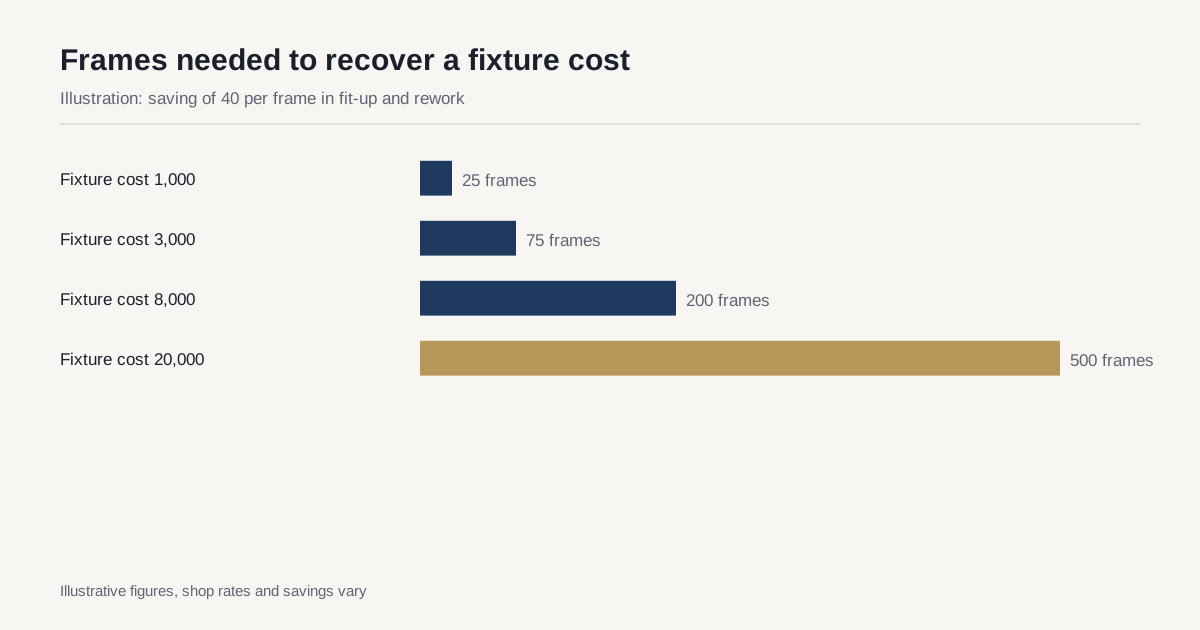
Take a simple example. A fixture costs 3,000 and saves 40 per frame in fit-up time and rework. The break-even is 75 frames. Numbers like these are illustrative and every shop’s labour rate and saving will differ, but the arithmetic is the same. For a design that will be ordered in tens of units a year over several years, a dedicated fixture makes sense. For a design that will change next quarter, a modular setup is safer.
Other benefits do not show in the per-unit saving: fewer rejects, lower variation between units and shorter lead time on repeat orders because the fixture is already waiting. These benefits matter most when your own assembly line depends on the frame fitting every time. The decision about moving from prototype to series is covered in prototype to production machine frames.
Ownership, storage and change control
Fixture disputes cluster around five questions. Settle them in the purchase order.
- Who pays. Common arrangements are customer-paid tooling, shop-paid tooling amortised into the unit price, or a split. State which applies and what the fixture cost is.
- Who owns it. Customer-paid tooling should belong to the customer, and the contract should say it can be removed on request. Shop-paid tooling belongs to the shop.
- Where it is stored and by whom. Large fixtures take floor space. Agree on labelling, storage conditions and a record of use.
- How it is maintained. Define periodic checks against a master or CMM, and who pays for repairs after normal wear.
- What happens on a design change. Small revisions can often be handled by modifying pads. Larger ones need a new fixture. Agree on how change costs are quoted.
A note about intellectual property: fixtures embed knowledge of your design. Mark them with your part number and require that a fixture built for your frame is not reused for another customer’s parts. The contract clauses are in the machine frame supply agreement checklist.
What to ask a partner shop
- Which fixture type would you propose for this volume, and why?
- How is the fixture checked, how often, and where is the record?
- What compensation for shrinkage will you build in, and based on what experience?
- Can you show a photo of a fixture for a comparable frame?
- What is the fixture cost, and who owns it?
Answers that include numbers and photos are a good sign. Vague answers suggest the shop will learn on your parts.
Fixtures that outlive the first order
A fixture is an asset, and assets need an owner. Photograph the fixture when it is accepted, record its identification number and note the date of its first check against the master. If the fixture is moved to another shop, the same record lets the new shop verify it before the first production run. Keep the check records with the fixture, not in someone’s email. Fixtures that are stored outdoors or under dusty conditions can corrode or warp, so ask where they are kept. A shop that can show a labelled rack and a maintenance log has treated tooling as part of the product.
Questions to ask after the first run
Once the first production run is finished, review the fixture together with the shop. Which clamps were slow to use, which locating pads wore, which joints still needed rework and where did the welder lose access? A short list of fixes after the first run often cuts labour on the second by a visible margin. Record the changes on the fixture drawing, so that the knowledge stays with the tool and not with one employee. Fixtures improve through use, and a buyer who asks for a short review after the first batch gets a better fixture for the same money.
Checklist
- Classify features by tolerance and decide which ones the fixture must control.
- Set fixture accuracy to about a quarter to a third of the tightest located tolerance.
- Choose modular tooling for short or uncertain runs and dedicated tooling for stable, higher volume.
- Put ownership, storage, maintenance and change terms in the purchase order.
- Require a first-article report from the fixture before releasing the production run. The routine is in first article inspection for large weldments.
If you are scoping tooling for a repeat frame, send the drawing with expected annual volumes. The network replies within 24 business hours with fixture options and costs.
Have a frame drawing to price?
Send it through for a manufacturability review and a matched quote from the heavy-fabrication network. Reply within 24 business hours.