Robotic or manual welding for small-batch machine frames
By Ryan, independent sourcing agent, Ho Chi Minh City, Vietnam
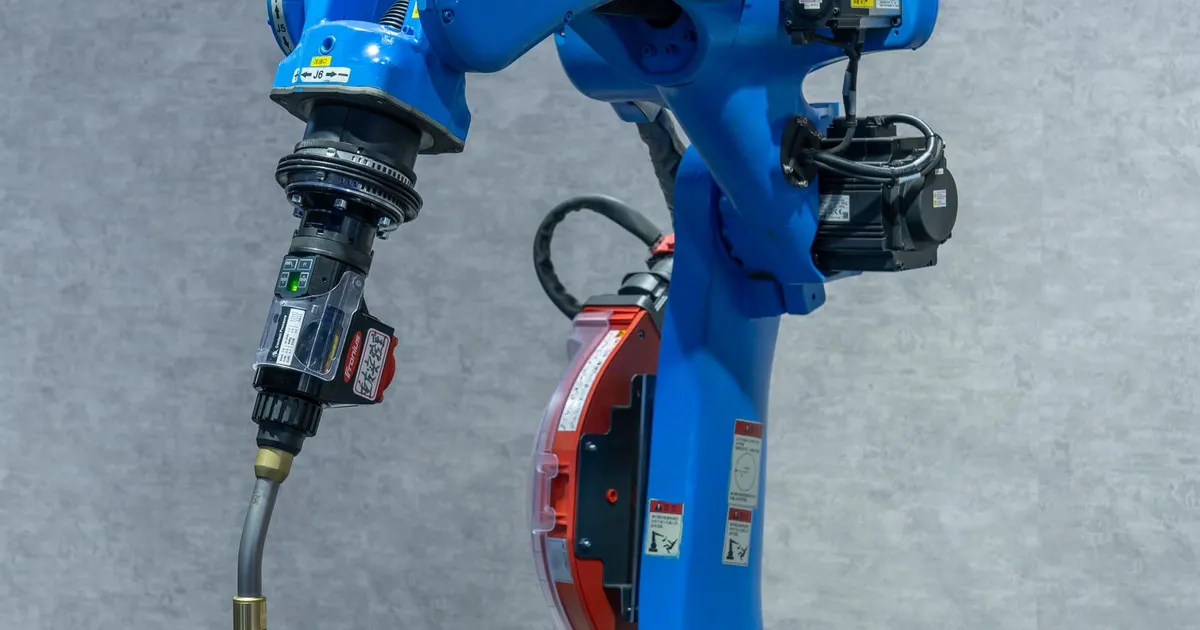
Buyers often ask whether a frame will be “robot welded”, as if the answer were a quality grade. It is not. Robotic welding is a way of spending money up front, on programming and fixturing, to save it on every part afterwards. Whether that trade pays off depends on how many frames you will order, how consistent the parts are before welding and how much of the structure a robot can physically reach.
For a one-off prototype the answer is almost always manual. For a run of several hundred identical brackets it is almost always robotic. Machine frames sit awkwardly in the middle: large, heavy, with plenty of joints that a robot can reach and plenty that it cannot. That is why many partner shops use both on the same frame.
What a robot actually changes
A skilled manual welder is flexible. They see a gap, adjust travel speed and weave, and carry on. A robot follows a programmed path with the same speed and torch angle every time. That gives three real advantages and one real cost.
Consistency. Bead size, travel speed and heat input repeat from part to part. For a frame produced in batches, dimensional repeatability between units improves because distortion becomes predictable.
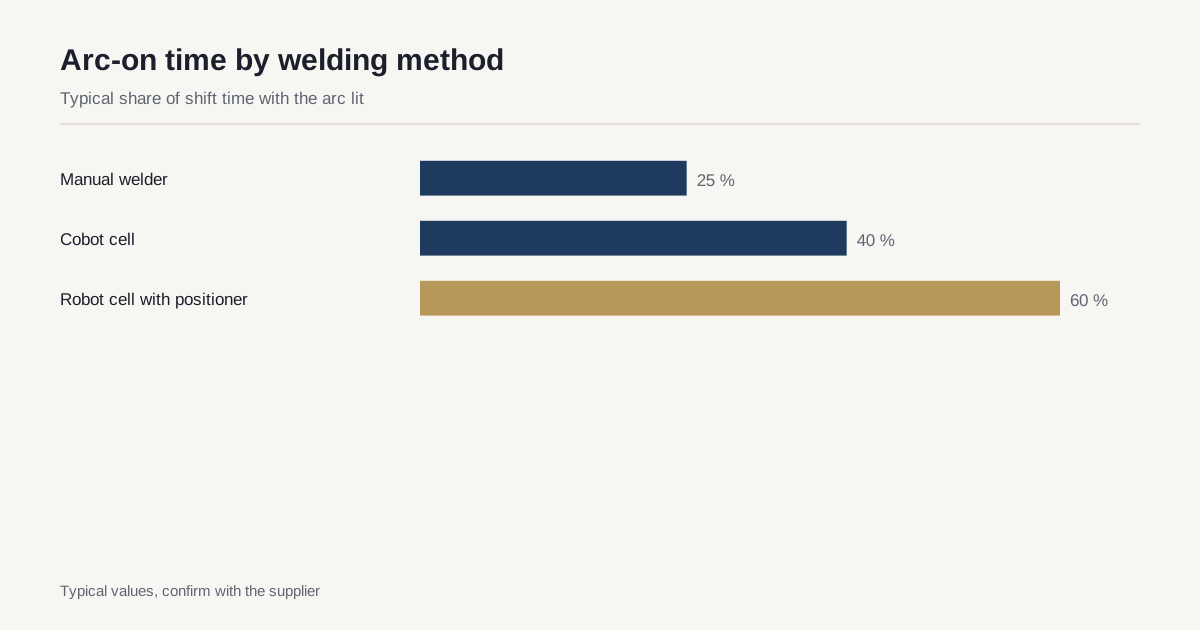
Arc-on time. A manual welder typically spends something like a quarter of the shift with the arc lit. The rest goes to fit-up, grinding, repositioning and cleaning. A robot cell with a positioner can reach around two to three times that, because the operator loads the next part while the robot welds.
Documented parameters. Current, voltage and wire feed are stored in the program. That makes it easier to show a customer that every unit was welded to the same procedure.
The cost is setup. Someone has to program the paths, build a fixture that locates parts within the robot’s tolerance, run a first article and adjust. That effort is fixed whether the batch is five frames or fifty.
Fit-up decides everything
A robot does not see the joint unless it is equipped with seam tracking or touch sensing. It welds where the program says. If the plates were cut with a bevel that varies, or the parts rest in the fixture 2 mm out of position, the weld lands in the wrong place or bridges a gap it was not set up for.
Guidance that shops commonly work from: fillet joints should be fitted with gaps small enough that the robot’s torch angle and wire stickout still deposit a correct throat. Larger or variable gaps need either sensing equipment or a manual tack and root pass first. Laser-cut and plasma-cut parts with tight tolerances suit robots well. Flame-cut plate with rough edges does not.
This is why a robotic quote for a frame often depends on the cutting method. Ask what process makes the parts and what tolerance the shop holds on them. Our guide to thick plate cutting methods covers how edge quality varies between processes.
Where robots and cobots fit on a machine frame
| Factor | Manual welding | Cobot cell | Robot cell with positioner |
|---|---|---|---|
| Best batch size | 1 to about 10 frames | about 5 to 50 sub-assemblies | 20 and above, repeat orders |
| Setup effort | Low, fixture optional | Moderate, hand-guided teaching | High, offline programming and fixture |
| Fit-up tolerance | Welder adapts | Needs reasonable fit-up | Needs tight, repeatable fit-up |
| Typical reach | Anything the welder can access | Small to medium parts | Parts that fit the positioner envelope |
| Thick multi-pass joints | Suitable | Possible with tracking | Suitable with multi-pass programs |
| Unit-to-unit repeatability | Depends on welder | Good | Best |
Cobots, the collaborative robots that a welder can guide by hand and that work without a safety cage, have changed the small-batch picture. They suit brackets, covers, mounting plates and small sub-frames where a full robot cell would be uneconomic. A cobot is slower than an industrial robot but cheaper to set up, so it fits batches that sit between “one-off” and “series”.
The numbers above are typical. Individual shops vary a lot, and a shop with a well-used robot cell will quote differently from one that has just installed its first.
Machine frames are usually a hybrid job
A large welded frame, say 3 metres long with ribs, flanges and heavy base plates, rarely goes into a robot as a single piece. The practical split looks like this:
- Sub-assemblies by robot or cobot. Rib packs, mounting brackets, cover frames and stiffener cassettes are welded in a fixture with repeatable geometry.
- Main assembly by manual welders. The sub-assemblies are fitted into the base, tacked, and the long structural welds are completed by hand with a controlled sequence.
- Stress relief and machining follow, as for any welded frame. See stress relieving welded machine bases for what that step involves.
That hybrid gives most of the repeatability benefit on the many small joints and keeps the flexibility of manual welding where a robot would struggle with access.
Qualification is the same either way
Mechanised or robotic welding still needs a qualified welding procedure. Under ISO 15614-1 or the AWS D1.1 equivalent, the shop qualifies a procedure for the material, thickness and joint, and the parameters in the robot program must sit inside that qualified range. A robot does not remove the need for a welding procedure specification, and it does not remove the need for inspection. Ask for the WPS reference for your joints, and ask who is qualified to run and adjust the cell. The standards themselves are compared in welding standards for machine frames.
How batch size should shape the quote
Ask partner shops to price a robotic option as two numbers, not one:
- A one-time setup cost for programming, fixture and first-article adjustment.
- A per-unit price once the cell is running.
Then compare it with the manual per-unit price. If setup costs 3,000 and the robot saves 60 per unit, the break-even is 50 units; those figures are an example and not a quote. A shop that can show the arithmetic usually understands its own process.
Think about the order pattern too. A frame ordered ten at a time, four times a year, can justify a fixture that a single order of ten would not. If the design is likely to change in the next six months, a hard-tooled fixture becomes a liability. Our note on moving from prototype to production frames covers how to stage that decision.
What to put in the RFQ
- State annual volume and order size, not just the first order quantity.
- State whether the drawing is frozen. Revisions cost more once a program and fixture exist.
- Give the cutting method you expect, or ask the shop to state theirs.
- Ask which joints the shop would weld robotically and which manually.
- Ask for the WPS reference and a statement of fit-up tolerance for robotic joints.
Reading a robotic quote
A robotic quote that looks cheap deserves a second look at what it leaves out. Check whether the price includes the fixture, the programming and the first-article welds, or whether those arrive later as separate lines. Check whether the shop plans to grind or rework weld starts and stops, which robots tend to leave more visibly than a welder does. Check also who owns the program: if the order moves to another shop, a program tied to a particular robot and fixture may not move with it. None of these points is a reason to avoid robotic welding. They are reasons to ask for the full picture before comparing prices, so that a robotic quote and a manual quote are measuring the same scope.
Checklist
- Under about 10 frames per order: expect manual welding on the main structure.
- Repeat orders of 20 or more sub-assemblies: ask for a robot or cobot option with setup priced separately.
- Parts cut by laser or plasma with consistent edges: good candidates for robotic welding.
- Rough flame-cut or variable parts: expect manual root passes.
- Always: confirm the welding procedure, inspection scope and sequence on the largest joints.
If you are deciding between a manual and robotic route for a frame, send the drawing and expected volumes. The network can quote both routes and the reply arrives within 24 business hours.
Have a frame drawing to price?
Send it through for a manufacturability review and a matched quote from the heavy-fabrication network. Reply within 24 business hours.