Fillet or full-penetration welds on a machine frame
By Ryan, independent sourcing agent, Ho Chi Minh City, Vietnam
Open a typical machine frame drawing and you will often find one of two extremes. Either every joint carries a “full penetration” note because someone wanted to be safe, or the weld symbols are missing and the shop decides joint by joint. Both outcomes cost money. The first adds days of welding and inspection to joints that never needed them. The second leaves the quality of the structure to whoever quotes lowest.
The honest answer is that a machine frame needs full penetration welds in a small number of places. Everywhere else a correctly sized fillet or a partial penetration groove does the job at a fraction of the heat input. This article sets out how to tell the difference, what each choice does to weld volume and distortion, and how to write it down so five partner shops quote the same thing.
What the three joint types actually are
A fillet weld is a triangular bead laid in the corner between two plates. The plates are not prepared, so fusion happens at the surface and a little way into each plate. The effective throat is roughly 0.7 times the leg length, which is why leg size is what the drawing specifies.
A partial penetration groove weld (PJP) has a bevel machined or flame cut into one or both plates, but the bevel stops short of the full thickness. A land of unfused material remains at the root. The weld carries load through its effective throat, which is the groove depth less any allowance the design code makes for the groove angle.
A full penetration groove weld (CJP, complete joint penetration) fuses the whole thickness of the joint. The root is either welded from both sides, or welded from one side onto a backing strip, or welded from one side and then back gouged and sealed from the other. When done properly, the joint is as strong as the thinner plate.
Why the choice matters for weld metal
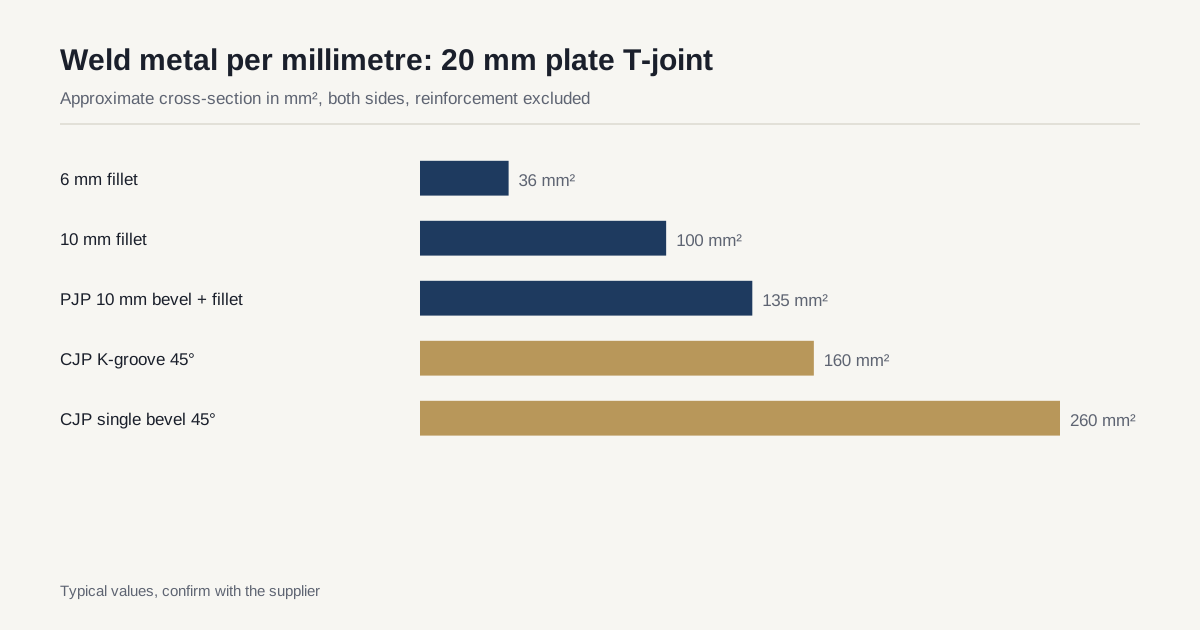
Weld metal volume drives cost, distortion and residual stress together. The groove geometry sets that volume before the welder strikes an arc. For a T-joint in 20 mm plate, a rough comparison per millimetre of weld length looks like this:
| Joint type | Approximate weld cross-section | Relative to 6 mm fillet | Typical use on a frame |
|---|---|---|---|
| 6 mm fillet, both sides | about 36 mm² | 1x | Ribs to base plates, stiffeners, light brackets |
| 10 mm fillet, both sides | about 100 mm² | about 3x | Heavily loaded joints where a calculation supports it |
| Single bevel PJP, 10 mm deep, plus fillet, both sides | about 135 mm² | about 4x | Column to base plate, moderate load transfer |
| K-groove CJP, 45° bevels | about 160 mm² | about 4.5x | Load path through the plate, fatigue-loaded joints |
| Single bevel CJP, 45° | about 260 mm² | about 7x | One-sided access, then back gouge or backing |
Figures come from simple geometry and exclude weld reinforcement, so treat them as typical values and confirm them with the shop. The pattern is what matters: stepping from a fillet to a full penetration joint multiplies the metal deposited several times over, and that multiplier turns up again in welding hours, inspection time and distortion. The levers for controlling movement are covered in controlling distortion on large weldments.
Where a machine frame genuinely needs full penetration
Most machine bases are stiffness-limited, not strength-limited. The stresses at the joints are low, and a fillet sized for the real load carries them with margin. Full penetration earns its place in a short list of situations.
Through-thickness loading. When a tension load pulls a plate away from the one it is welded to, a fillet puts the load across the weak direction of the plate. Think of a lifting lug, a heavy motor mount hanging from a vertical plate, or a column that sees uplift. A full penetration T-joint, usually with a K-groove, transfers that load into the plate properly.
Fatigue-loaded joints. A frame under repeated cyclic load, such as a press frame or a vibrating screen, can fail at the weld toe or root long before static strength matters. Fatigue design standards rate full penetration joints with ground flush or controlled profile far better than the same joint with an unfused root.
Sealed or pressurised cavities. If a hollow section must hold fluid, or must be airtight for coolant or lubrication channels, a continuous full penetration weld removes the unfused crevice where leaks start.
Primary load paths named by the designer. Some customers specify full penetration for the joints between the main structural plates by company standard. That is a legitimate requirement. Put it on the drawing as a requirement and not as an assumption.
If a joint is not on that list, ask what the penetration is supposed to achieve before specifying it.
What full penetration costs beyond the weld
A CJP joint is more than a bigger bead.
- Edge preparation. Bevels are cut by plasma, oxy-fuel or machining. Thick plate needs this before assembly, and the cut edges must be clean and to the correct angle.
- Root control. Gap, root face and alignment must be right at fit-up. Poor fit-up produces lack of fusion that no amount of cover passes will repair.
- Back gouging or backing. Welding from both sides means gouging the root clean, usually by air arc and grinding, then testing the gouged groove for cleanliness.
- Preheat and interpass control. Thicker joints and more passes mean tighter thermal control. See weld preheat on thick plate for the numbers shops work from.
- Inspection. CJP joints normally call for volumetric testing, ultrasonic or radiographic, plus surface testing. The scope belongs on the drawing. Our guide to NDT for machine frame welds describes which method fits which joint.
Together these can double or triple the labour on a joint compared with a fillet. On a frame with 40 metres of weld, the choice moves the schedule.
How to write it on the drawing
Use the weld symbol system and be explicit. The symbol set is explained in weld symbols for machine frame drawings. A usable drawing note has four parts:
- The joint type per location: fillet, PJP with depth or CJP.
- The size: leg length for fillets, effective throat or groove depth for PJP.
- The acceptance level, for example ISO 5817 quality level B, C or D, or the AWS D1.1 equivalent. Name the standard and check the level against the load.
- The inspection scope: visual 100 percent, magnetic particle or penetrant percentage, ultrasonic or radiographic on named CJP joints.
A short general note helps shops price without guessing:
Unless otherwise shown, all welds are continuous 6 mm fillets. Joints marked CJP are full penetration, inspected per drawing note 4.
Then mark only the joints that need more. A drawing that flags six CJP joints and calls out the rest as fillets quotes much more consistently than a drawing that says “all welds full penetration”.
When the partner shop pushes back
A good fabricator will sometimes propose a change. Take it seriously when it comes with a reason. A shop might suggest swapping a CJP at a low-stress joint for a PJP plus fillet, which saves heat without losing needed strength. Or it might ask for a joint to be re-detailed so a welder can reach the root. Both are signs of a shop reading the drawing carefully.
Treat with caution a shop that agrees to everything immediately. It may be assuming it can reduce penetration later, and nobody checks. Asking for the weld procedure specification (WPS) and the welder qualification record for the joint types on your drawing is a normal request.
Checklist before you release the drawing
- List the joints that carry through-thickness, fatigue or sealed-cavity duty. Only those are candidates for CJP.
- Size every fillet from a calculation or a stated rule, not from habit.
- State quality level, standard and NDT scope for each CJP joint.
- Check that a welder can physically reach each root, and whether back gouging is possible.
- Add a general fillet note so unmarked joints are not left open.
- Ask quoting shops for their weld sequence on the largest CJP joints.
If you want a frame drawing reviewed for joint types before it goes to a shortlist, send it through the RFQ page. The review comes back within 24 business hours and flags where a CJP callout could be relaxed or where one is missing.
Have a frame drawing to price?
Send it through for a manufacturability review and a matched quote from the heavy-fabrication network. Reply within 24 business hours.