Plasma, laser or oxy-fuel cutting for thick frame plate
By Ryan, independent sourcing agent, Ho Chi Minh City, Vietnam
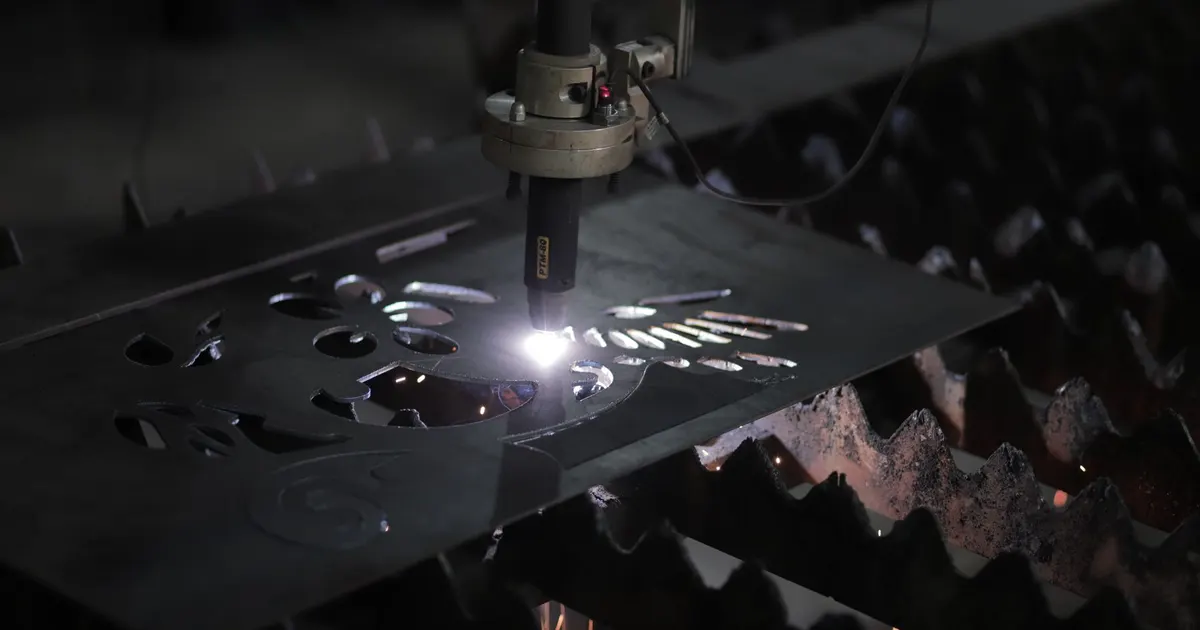
Every welded machine frame starts as flat plate cut to shape. That first operation decides how well the parts fit together, how much grinding the welders do and how much stock the machinist finds on the finished frame. Yet drawings rarely say how the plate should be cut, and quotes rarely say how it was priced.
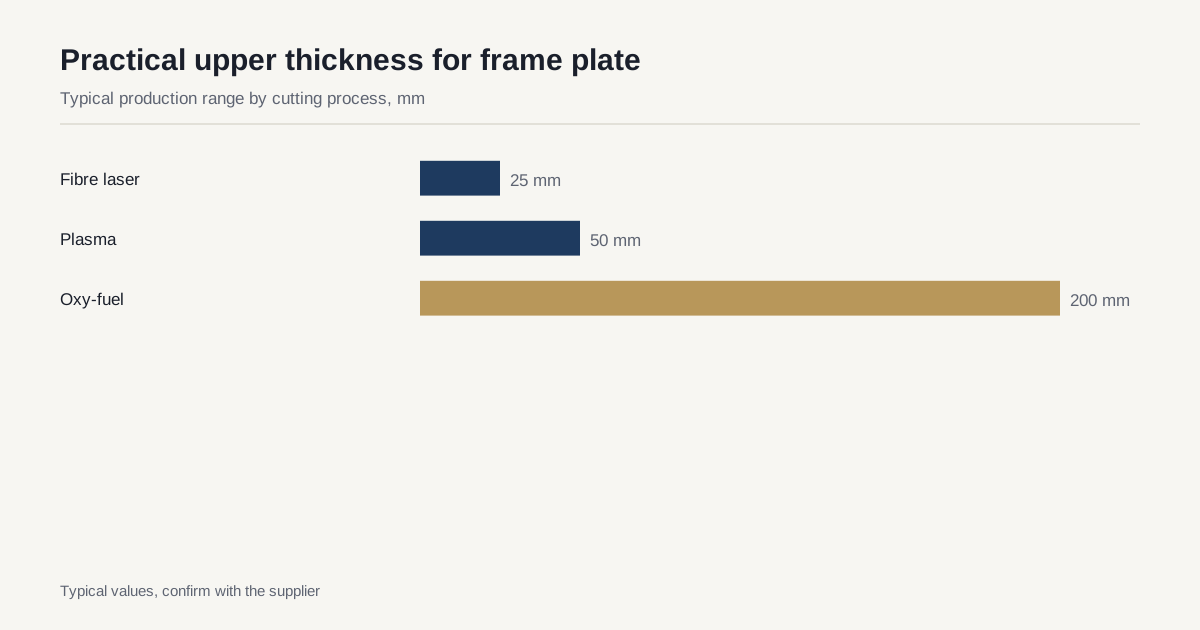
Three thermal cutting processes handle almost all frame plate: oxy-fuel (flame), plasma and fibre laser. They overlap in thickness, but they differ in edge quality, heat input and cost per metre. This article compares them for the 10 to 100 mm plate that welded machine bases use, and shows what to ask for so that the cutting method suits the frame and not just the shop’s machine schedule.
How each process cuts
Oxy-fuel burns the steel. A preheat flame brings the plate to ignition temperature, a jet of pure oxygen oxidises it, and the iron oxide is blown out of the cut. It works on carbon and low-alloy steel only, and it works on very thick plate, well beyond the range of plasma and laser. Speed is slow and the heat-affected zone is wide.
Plasma melts the steel with an electrically ionised gas jet and blows the molten metal away. It cuts any conductive metal, runs several times faster than oxy-fuel on plate below about 50 mm and leaves a narrower heat-affected zone. Modern high-definition systems improve edge squareness markedly over conventional plasma, but the cut face is still not perfectly square.
Fibre laser melts or vaporises the steel with a focused beam and clears it with an assist gas. It gives the narrowest kerf, the squarest edge and the smallest heat-affected zone, at the price of a practical thickness limit. Machines with very high power extend that limit, but for most production shops it sits in the 20 to 30 mm range for carbon steel.
Side-by-side comparison
| Property | Oxy-fuel | Plasma | Fibre laser |
|---|---|---|---|
| Typical frame plate range | 20 to 200 mm and above | 6 to 50 mm | 3 to 25 mm |
| Typical kerf | 1.5 to 3 mm | 2 to 5 mm | 0.3 to 1 mm |
| Edge squareness | Fair, visible draft | Fair to good, small bevel angle | Very good |
| Heat-affected zone | Widest | Moderate | Narrowest |
| Speed on mid-thickness plate | Slowest | Fast | Fastest in its range |
| Materials | Carbon and low-alloy steel | Any conductive metal | Steel, stainless, aluminium |
| Bevel capability | Yes, with tilted torches | Yes, with a bevel head | Limited, thin plate only |
All values are typical. Individual machines and gas settings change them, and a shop should confirm what it holds on your thickness.
What edge quality does to the rest of the job
Cutting quality shows up later in three places.
Weld fit-up. If parts are cut square and to size, they sit together with small, even gaps and the welder spends time welding. If edges have draft, dross or notches, the welder grinds, shims and fills. In robotic welding a variable gap is a bigger problem still. See robotic welding for small batches for how fit-up drives the choice.
Machining allowance. Where a cut edge will be machined, the shop needs to leave enough stock to clean up the cut surface and any distortion. A drawing that leaves 1 mm on a surface cut by oxy-fuel is asking for trouble. A realistic allowance depends on the process and thickness. Ask the shop to state theirs.
Hardened or altered edges. Thermal cutting heats the edge, and the steel cools quickly because the plate absorbs the heat. On higher-carbon grades this can leave a thin hard layer. If a cut edge will be machined, hard spots can wear tools. If the edge will be welded, surface oxides and, with nitrogen-based plasma gas, a nitrided layer can cause porosity in the weld. The usual remedy is to grind the cut edge before welding. Ask whether the shop grinds weld-prep edges as standard.
Cutting and distortion
Cutting thick plate also moves it. Plate leaves the mill with residual stress from rolling and cooling. Cutting a large profile from the plate releases some of that stress and the part can bow, sometimes visibly. Narrow strips cut from the edge of a plate are the worst offenders.
Shops manage this by cutting symmetrically, by leaving parts tabbed to the sheet until the end of the program and by flattening or stress relieving critical parts. Normalised plate, discussed in normalised steel plate, starts with lower residual stress. On a frame where flatness of base plates matters, ask the shop how it controls bow after cutting.
Weld preparation cuts
Thick plate needs bevelled edges for full penetration welds. All three processes can prepare bevels in some form:
- Oxy-fuel with multi-torch heads cuts V, X and K bevels on very thick plate.
- Plasma with a tilting bevel head cuts bevels on plate up to about 50 mm, with some loss of accuracy at steeper angles.
- Laser bevelling is limited to thinner plate, so heavy frame parts normally use plasma or oxy-fuel for weld prep.
If the drawing calls for a specific bevel angle and root face, say so with a tolerance. A bevel angle of 30 degrees means little unless the drawing says plus or minus how much. The joint types themselves are explained in fillet or full-penetration welds.
What to write on the drawing
Name the standard that defines cut quality. ISO 9013 sets quality ranges for squareness and surface roughness of thermally cut edges. Many drawings simply state “ISO 9013 range 3” or “range 4” for edges that matter and leave the rest unspecified. If the frame ships to the EU under EN 1090, check which cut-quality requirement applies to your execution class, because EN 1090-2 refers to cut surface quality and hardness limits.
A short note works well:
Thermally cut edges to ISO 9013 range 4 unless noted. Edges prepared for welding to be ground free of dross and oxide before fit-up.
How shops price cutting
Cutting is priced by the metre and by the pierce. On plate above 30 mm, pierce time and gas use become a noticeable share of the cost. Nesting efficiency also matters: parts packed tightly on a plate waste less steel, and on thick plate the steel is the largest line in the quote. Nested layouts depend on plate sizes, so aligning part dimensions with standard plate widths helps. Lead times for plate are covered in plate procurement lead time.
A practical rule for choosing
As a working rule, let thickness and edge use decide. Parts up to about 25 mm that need tight fit-up or robotic welding suit the laser. Parts from 12 to 50 mm that will be welded manually and ground at the joint suit plasma. Anything thicker, or any large weld-prep bevel, goes to oxy-fuel or a plasma bevel head. Shops that run all three processes will pick the cheapest one that meets your edge requirement, so state the requirement rather than the process. If you do name a process, name it for a reason, such as bevel capability or heat-affected zone, so the shop can propose an alternative that meets the same need at a lower cost.
Checklist
- Choose the process by thickness first: laser to about 25 mm, plasma to about 50 mm, oxy-fuel above that.
- State the edge quality standard for edges that will be welded or machined.
- Specify bevel angle, root face and tolerance when weld prep is cut.
- Ask how the shop controls bow after cutting large profiles.
- Ask whether weld-prep edges are ground before fit-up.
- Leave machining allowance that matches the cutting process.
If you want to know which cutting method the network would use for your parts, send the drawing and ask for the process to be named in each quote. The reply comes within 24 business hours.
Have a frame drawing to price?
Send it through for a manufacturability review and a matched quote from the heavy-fabrication network. Reply within 24 business hours.