Normalised plate and why it machines more predictably
By Ryan, independent sourcing agent, Ho Chi Minh City, Vietnam
Two plates of S355 steel can have the same chemistry, the same yield strength and the same price per kilogram, and still behave differently when a milling cutter removes the top 5 mm. One stays flat. The other bows. The difference is not in the grade name but in how the plate was finished at the mill, and in particular whether it was normalised.
Delivery condition is one of the least-discussed lines on a material specification, and one of the most expensive to get wrong when a precision frame has to hold flatness after machining. This article explains what normalising is, how the common delivery conditions differ, what each means for welding, stress relief and machining and when it is worth paying for.
What normalising does
Normalising is a heat treatment. The plate is heated to a temperature above the point where the steel becomes fully austenitic, typically around 900 °C for structural grades, held long enough to heat through and then cooled in still air. The result is a refined, uniform grain structure.
Three effects matter for frames:
- More uniform properties. Yield, tensile strength and toughness vary less from surface to centre and from edge to edge than in as-rolled plate.
- Better toughness. The finer grain improves impact energy, which is why normalised grades in EN 10025-3 (S355N and S355NL) carry impact requirements to lower temperatures.
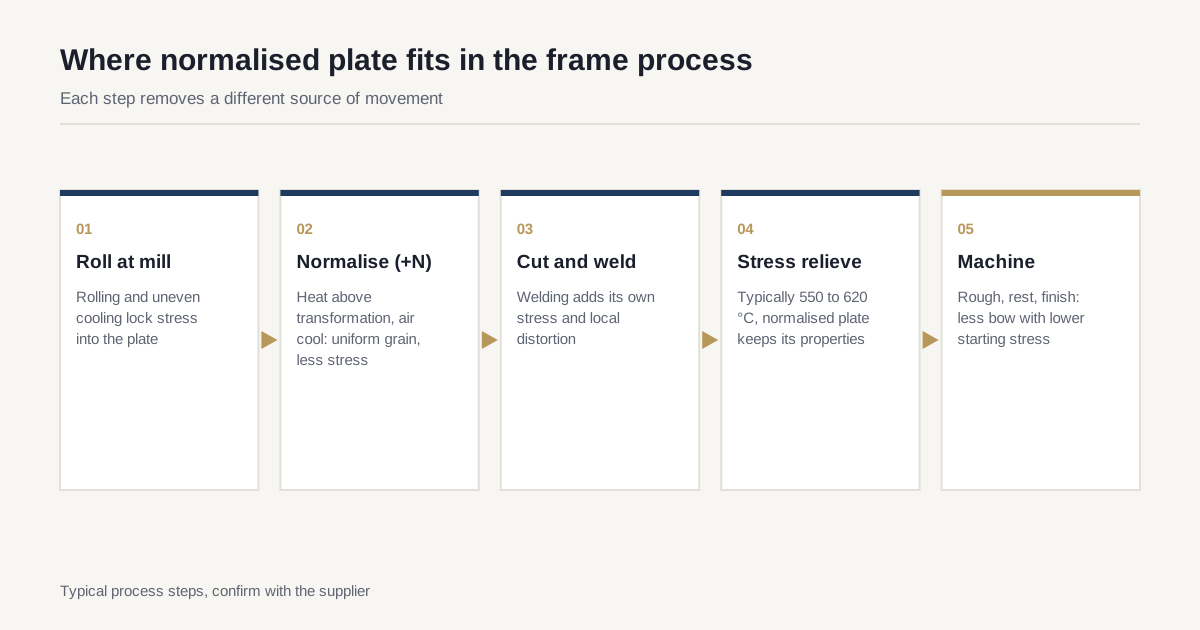
- Reduced residual stress. Rolling and uneven cooling lock stress into plate. Heating to normalising temperature relieves most of it. Air cooling leaves some stress behind, but typically less than in as-rolled plate.
The common delivery conditions
| Condition | Standard and suffix | How it is made | Notes for frames |
|---|---|---|---|
| As rolled | EN 10025-2 S355J2 (+AR) | Rolled and left to cool | Cheapest, most available, variable stress |
| Normalised | EN 10025-3 S355N, S355NL (+N) | Heat treated after rolling | More uniform, stable under stress relief |
| Thermomechanically rolled | EN 10025-4 S355M, S355ML (+M) | Controlled rolling and cooling | Low carbon equivalent, easy welding, sensitive to heat |
| Quenched and tempered | EN 10025-6 S460Q and above | Hardened and tempered | High strength, special welding rules |
The common choice for machine frames is between as-rolled and normalised plate, with TMCP as a third option for heavily welded structures.
Why it matters for machining
Residual stress in the plate is the problem. While the plate is whole, the stresses balance. When a machinist removes material from one side, the balance shifts and the plate moves to a new equilibrium. This is the familiar experience of a surface that was flat when clamped and bowed after release. The effect scales with the amount of material removed, the stress level and the asymmetry of the cut.
Normalised plate has less locked-in stress to release. It does not eliminate movement, particularly when a large asymmetric pocket is cut, but the movement is smaller and more predictable. For a frame where a mounting face must hold 0.05 mm after finish machining, starting from lower-stress plate reduces the risk of rework.
This is separate from the stress created by welding. Welded frames get a thermal stress relief after welding for that reason, as described in stress relieving welded machine bases. Normalised plate reduces the first source of stress, the mill, while stress relief handles the second, the weld. For an unwelded plate, such as a machined base plate or spacer, normalised delivery may be the only stress reduction it receives.
Why TMCP plate needs care
Thermomechanically rolled plate is popular because it is strong, tough and easy to weld, with a low carbon equivalent. Its properties come from the rolling process, not from a furnace cycle, and that makes them sensitive to heat. Holding TMCP plate near or above its tempering range can soften it and lower its strength. Stress relief of welded frames at about 550 to 620 °C may fall into that range for some grades.
The consequence is a simple rule. If a frame will be stress relieved, check with the plate supplier that the grade keeps its properties through the planned cycle. Normalised plate has no such concern, because it has already been through a higher temperature than any stress relief. For frames that are welded and thermally stress relieved, normalised plate is the safe default.
What it costs
Normalising adds a heat treatment step at the mill or at a processor. Expect a price premium, often in the range of a few percent to ten percent or more depending on thickness, tonnage and market. Lead time grows too: normalised plate is a smaller market than as-rolled, and thin or odd sizes may need to be sourced specially. The topic of lead times for heavy plate is covered in plate procurement lead time.
Cost should be weighed against rework. For a frame with tight machined flatness, the cost of a re-machine or a scrapped base outweighs the premium on plate. For a frame with generous tolerances, normalised plate is rarely justified.
When to specify it
Normalised delivery is worth considering when:
- Machined flatness is tight, and large areas will be machined away from a single face.
- Thick plate is machined asymmetrically, such as a base plate pocketed from one side.
- The part is not stress relieved after welding, or is not welded at all.
- Toughness is a requirement, especially thick plate and low temperature, where S355N or S355NL is a natural fit.
- The customer specification asks for it.
It is rarely needed when frames will be welded and then stress relieved, and when tolerances are generous.
Alternatives that reach the same goal
Normalised plate is not the only route to a stable frame. Cheaper alternatives are available:
- Stress relieve the plate before machining. A shop can stress relieve cut parts before rough machining at a lower cost than buying normalised stock.
- Rough machine, rest, finish machine. Remove most of the stock, allow the part to relax, then finish. This costs machining time and requires planning. See machining large weldments.
- Balance the cuts. Machine both faces alternately so the stress release is symmetric.
Often a combination is best: as-rolled plate, stress relief after welding and a staged machining plan.
How to specify it
State the delivery condition and the standard:
Plate: S355N (EN 10025-3), delivery condition +N. Mill certificate EN 10204 type 3.1 stating the heat treatment.
The mill certificate should say which delivery condition applied. The various types of certificate and what they prove are described in mill certificate types. If the shop proposes an equivalent from a different standard, ask for the chemistry and delivery condition in writing.
Checking what you received
Ask for the mill certificate to state the delivery condition, and check that the heat treatment record matches. A certificate that says nothing about delivery condition does not prove normalisation. For critical frames, a shop can also check hardness across the plate, which gives a rough indication of uniformity, or request a plate flatness check before cutting. These checks cost little compared with machining a frame from the wrong stock. If a supplier substitutes as-rolled plate for normalised plate, the price should change and the change should be recorded in writing.
Normalising and plate thickness
Normalising works best on plate that can heat and cool evenly. Very thick plate cools slowly in the core, so the structure can differ between the surface and the centre, and the standards allow for this by adjusting property limits with thickness. On thin plate, normalising can cause some distortion, and the mill may flatten the plate afterwards. For most frame plates between 10 and 60 mm, normalised delivery is a routine product. Above that range, check availability and lead time before committing the design to it.
Checklist
- Decide whether the frame is stress relieved and whether tight flatness follows machining.
- If machining large asymmetrical areas on plate, consider normalised delivery.
- If stress relief is planned, check TMCP plate against the planned cycle.
- Write delivery condition on the drawing and require a certificate that states it.
- Compare the plate premium with the cost of rework.
- Ask the shop for its machining plan, including rest periods.
To see how partner shops would plan material and stress relief for your frame, send the drawing. The network replies within 24 business hours.
Have a frame drawing to price?
Send it through for a manufacturability review and a matched quote from the heavy-fabrication network. Reply within 24 business hours.