Square tube or I-beam for a light machine frame
By Ryan, independent sourcing agent, Ho Chi Minh City, Vietnam
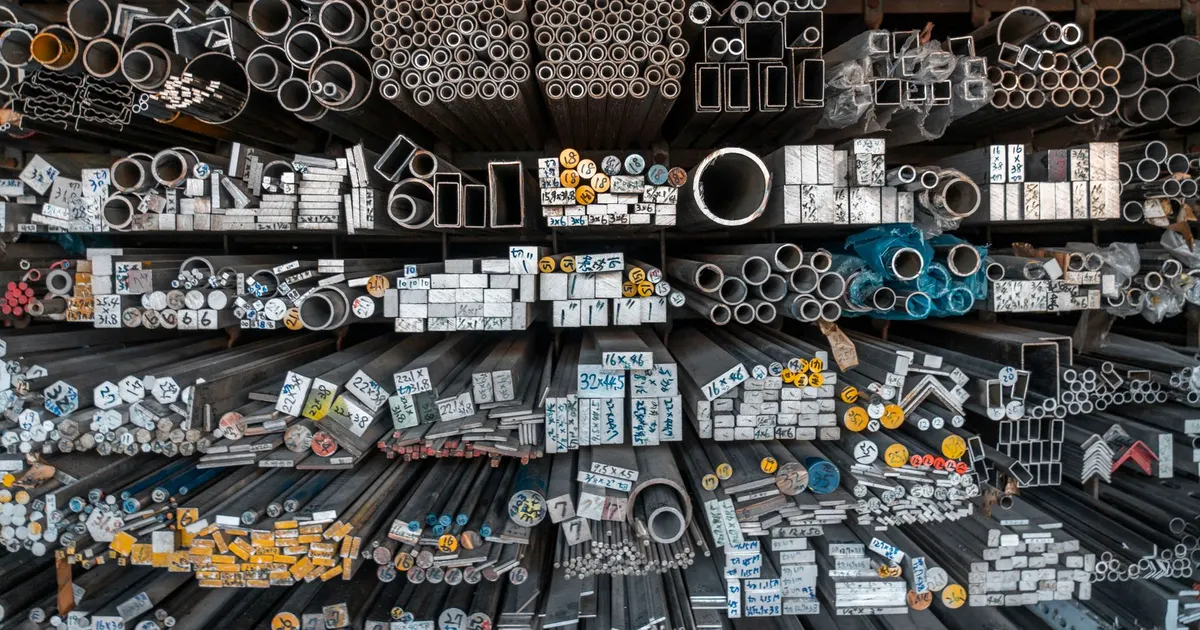
Plate gets most of the attention in heavy machine bases, but a large share of production machines sit on frames made from standard sections: hollow tube, I-beam, channel and angle. For test stands, assembly stations, packaging equipment and light CNC machines, that is often the right choice. The decision between tube and I-beam is one of the first design choices, and it is often made by habit.
The two section families behave very differently. A closed tube resists twisting; an open I or H section does not. An I-beam is efficient in bending about one axis and easy to connect with plates; a tube is stiff in every direction and harder to join in awkward angles. This article compares them for light frames and explains the practical points that affect the quote. Section choice is covered with the other design decisions in our guide to machine frame design.
The main difference is torsion
A closed section such as square or rectangular hollow section (SHS or RHS) carries torque as a circulating shear flow around the whole perimeter. An open section such as an I-beam can only twist by differential bending of its thin flanges and web, which is far less efficient.
A simple comparison shows the scale. Take a 100 × 100 × 5 mm square tube and an HEA 100 H-section, both common sizes:
| Property | SHS 100 × 100 × 5 | HEA 100 |
|---|---|---|
| Mass per metre | about 14 kg | about 17 kg |
| Bending stiffness, strong axis | about 180 cm⁴ | about 350 cm⁴ |
| Bending stiffness, weak axis | about 180 cm⁴ | about 130 cm⁴ |
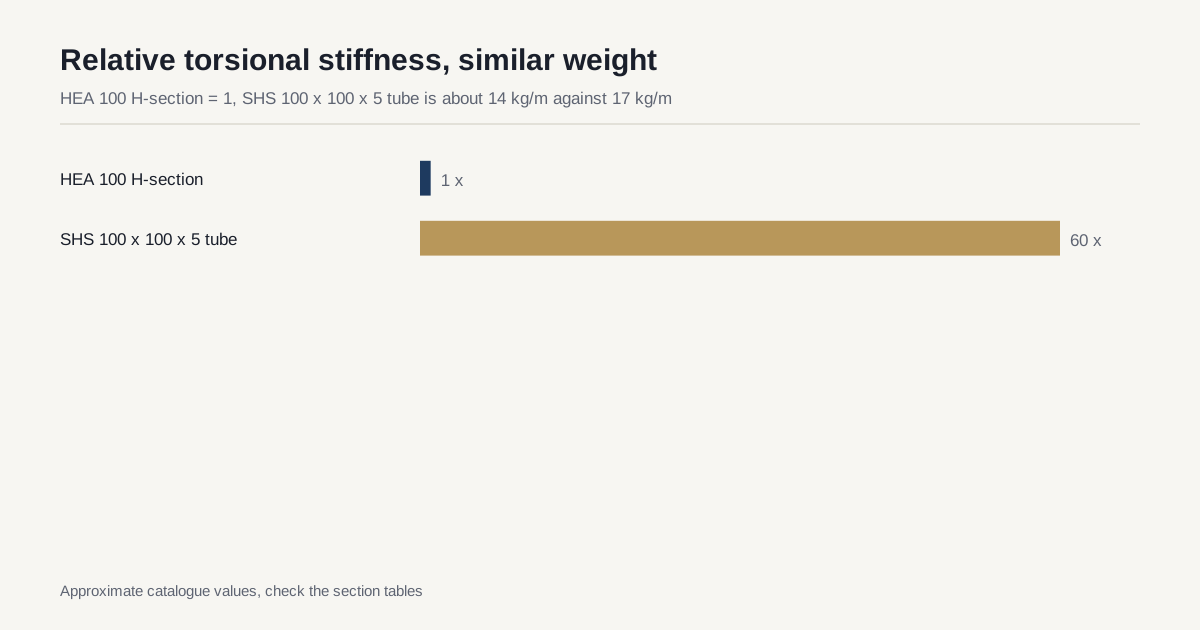
| Torsion constant | several hundred cm⁴ | about 5 cm⁴ |
The values are approximate catalogue figures, and you should check the section tables for the exact grade and supplier. The pattern is clear: the tube weighs slightly less, has the same bending stiffness in both directions and a torsion constant that is more than fifty times larger. The H-section is stronger about one axis only.
For a frame that carries equipment which can twist it, such as a table with an off-centre load or a machine base on a levelling foot at each corner, torsional stiffness is usually what limits performance. That is why many light machine frames are built from tube.
Where the I-beam still wins
Bending in a known direction. Where the load acts in the plane of the web and bracing prevents sideways movement, an I or H section carries more bending for the same weight. Gantry beams, crane runways and long spans under vertical load fit this pattern.
Connections. Flanges give flat surfaces for bolting and welding. End plates, gussets and brackets weld on easily. Tubes are less forgiving: flat connections need cut-outs, and angled joints need mitres or saddles.
Cost per kilogram. Rolled I and H sections are a high-volume product and often cost less per kilogram than hollow section, which has an extra forming and welding step. In some markets the difference is modest.
Availability in large sizes. Heavy H-sections are widely stocked. Large RHS above about 250 mm and wall thicknesses above 12 to 16 mm are less common.
Fabrication differences
| Factor | Tube (SHS, RHS) | I or H section |
|---|---|---|
| Joining | Needs cope or mitre cuts, internal access limited | Flat flanges, simple plate connections |
| Weld distortion | Low per joint, closed section resists | Higher, open section moves more |
| Corrosion protection | Inside is sealed or must be treated | All surfaces accessible |
| Straightness at delivery | About 0.15 percent of length under EN 10219 | Similar order under EN 10034 |
| Cutting | Saw or laser, laser tube cutters give precise copes | Saw or plasma |
Closed sections need sealing. A hollow section with open ends or unsealed joints can trap moisture and corrode from the inside. Seal ends with welded caps, or provide a vent and drain hole in galvanised designs. For painted frames, continuous welds seal the interior and stop moisture entering.
Tolerances are looser than they look. EN 10219 for cold-formed hollow sections permits wall thickness variation of about 10 percent and straightness deviation of about 0.15 percent of length, which is 3 mm over 2 metres. A frame that uses tube and must hold 1 mm over a metre needs machining or fit-up control. The same point applies to plate, discussed in plate thickness tolerances.
Corners are rounded. Cold-formed tube has outer corner radii of about two to three times the wall thickness, so a square box does not have sharp edges. Mating a plate to a tube side needs to leave room for the radius.
Light frames in practice
For frames that carry modest loads and need to be built in small numbers, a typical approach is:
- Main rails from RHS or SHS, sized for stiffness, with a wall thickness of 4 to 8 mm.
- Cross members and bracing from smaller tube or from angle for diagonal bracing.
- Machined plates welded on top for mounting rails, guides or equipment. Plates are flame or laser cut and welded onto tubes, then machined flat as a sub-assembly.
- Levelling feet on welded base plates, which spread the load and make room for adjustment.
This approach gives a lot of stiffness for moderate weight, and it keeps welding simple. A light frame built this way may still need stress relief or a stabilisation step if machined features have tight tolerance. The heavier alternatives are compared in bolted versus welded frame construction.
Choosing the grade and standard
Tube is commonly supplied to EN 10219 for cold-formed sections and EN 10210 for hot-finished sections, with grades such as S355J2H, where the H marks a hollow section. Equivalents elsewhere include ASTM A500 for cold-formed tube and Chinese GB/T 6728. The impact grade logic is the same as for plate; see S355J2 or S355JR. Write the standard and grade on the drawing and allow equivalents so the shop can buy what its supplier has.
Aluminium as an alternative
Where weight matters more than cost, aluminium sections are an option, though welded steel is stiffer per unit cost. Modular aluminium profile systems suit light enclosures and stations; they are compared with welded steel in aluminium extrusion frames versus welded steel frames.
Cutting and joining tube
Tube joints reward some planning. A butt joint between two tubes at right angles needs one end shaped to the profile of the other, called coping or fish-mouthing, and the quality of that cut decides the weld gap. Laser tube cutting gives precise copes and slots, while a saw and a hand grinder give wider and more variable gaps. Mitre joints at 45 degrees are simple to cut but concentrate weld metal at the corner. Ask the shop how it cuts tube joints, because the answer tells you how much of the fit-up depends on the welder’s judgement and how much on the cutting.
Mixing sections in one frame
Few frames use one section type throughout. A common arrangement uses rectangular tube for the long rails, square tube for the legs and cross members, angle for light bracing and plate for the top and the feet. The mix lets each member do what it does best. The cost is more stock items and more cutting setups, so keep the list short and reuse sizes wherever the design allows. If the frame is likely to be built in a series, ask the shop to propose a section list that matches its supplier’s regular stock, since that cuts both price and lead time.
Checklist
- Choose tube when the frame sees twisting loads or needs equal stiffness in both directions.
- Choose I or H section for long spans loaded in one plane and for simple plate connections.
- Check section tables for actual stiffness values, not rules of thumb.
- Seal or drain hollow sections to avoid internal corrosion.
- Design with realistic tube tolerances and machine critical faces after welding.
- State standard, grade and acceptable equivalents on the drawing.
To compare how partner shops would build your frame from standard sections, send the drawing. The network replies within 24 business hours.
Have a frame drawing to price?
Send it through for a manufacturability review and a matched quote from the heavy-fabrication network. Reply within 24 business hours.