S355J2 or S355JR: the impact grade question on machine frames
By Ryan, independent sourcing agent, Ho Chi Minh City, Vietnam
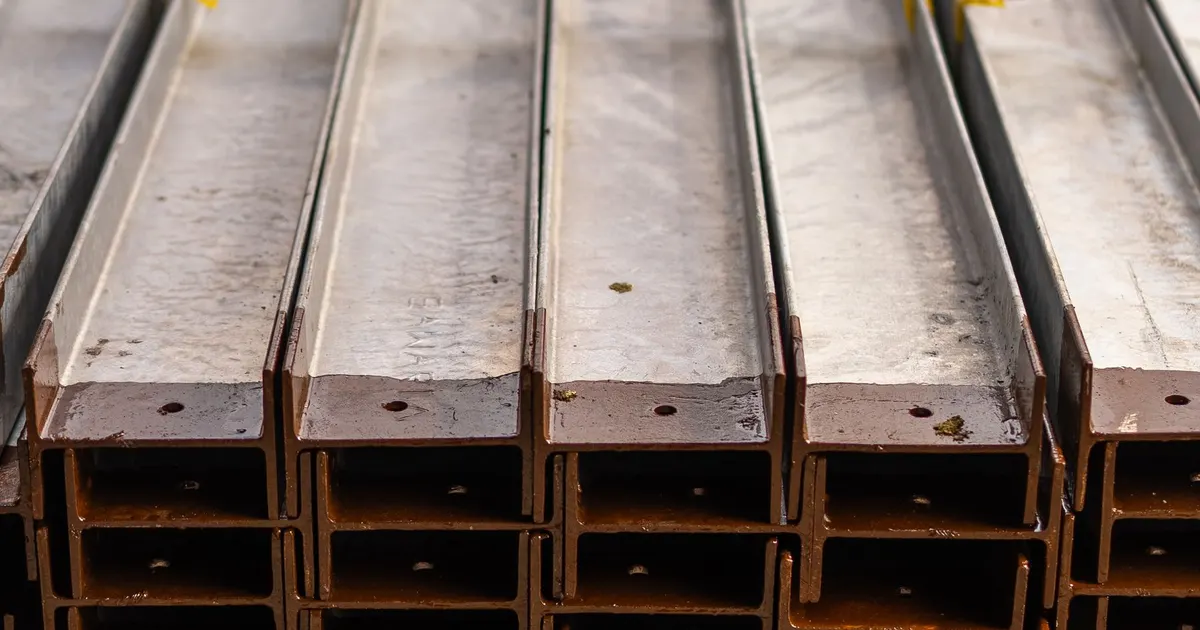
Two steel plates can share a name, a yield strength and a price within a few percent, and still differ in a property that only appears when the plate is struck cold. That is the difference between S355JR and S355J2. On a drawing it is one character. In the workshop it changes which plate the shop orders, how it is documented and sometimes how long it takes to arrive.
Most machine frames do not need the better grade. Some do. This article explains what the suffixes mean, when impact toughness matters for a welded base, what the common alternatives are and how to write the requirement so a shop cannot read it two ways.
What the designation says
S355 is a structural steel with a minimum yield strength of 355 MPa in thin sections. The letters that follow describe the impact test the steel must pass under EN 10025-2:
| Designation | Charpy V-notch test | Minimum energy | Typical equivalent |
|---|---|---|---|
| S355JR | at +20 °C | 27 J | Q355B, A572 Gr.50 (no impact requirement) |
| S355J0 | at 0 °C | 27 J | Q355C |
| S355J2 | at -20 °C | 27 J | Q355D |
| S355K2 | at -20 °C | 40 J | Check the supplier’s mill certificate |
A Charpy test breaks a small notched bar with a swinging hammer and measures the energy absorbed. Steel that absorbs more energy at a given temperature is tougher, meaning it is more likely to bend and tear than to snap. The J, K and number suffix tell you the test temperature and the energy required.
The equivalents in the right-hand column are approximate. Chinese GB/T 1591 grades Q355B, C and D run similar impact tests at +20, 0 and -20 °C, though the minimum energy value differs, and US A572 Gr.50 specifies no impact test unless the buyer adds one. Never treat an equivalent as automatic. Check the mill certificate for the actual test result.
Why toughness matters at all
Steel changes behaviour with temperature. Above a transition range it is ductile, and a crack in it grows slowly with a lot of deformation. Below that range it becomes brittle, and a crack can run quickly with little warning. Thick sections, sharp notches, high stress and fast loading all push a structure toward brittle failure. The impact grade is a way of buying margin against that.
For a machine frame that stays indoors at room temperature, on a shop floor with stable conditions, brittle fracture is a remote concern. The plate is usually thick for stiffness, not strength, and the working stress is low. That is why JR is adequate on most static bases.
When J2 earns its place
Several conditions make the higher grade a sensible choice.
Cold service or transport. A frame installed outdoors in winter, shipped through cold climates or stored unheated can see temperatures near or below freezing. A frame that sits in a container crossing northern waters in winter can get cold enough to matter, particularly before it is put into service.
Thick plate. Toughness requirements rise with thickness, because a thick plate cools slowly at the mill and develops a coarser structure, and because thick sections restrain a growing crack more. Design rules for steel structures link permitted thickness to the steel’s toughness grade and the lowest service temperature. Many fabricators move to J2 above 25 to 30 mm as a matter of habit.
Dynamic or shock loading. Presses, forging equipment, crushers and vehicles that impose impacts all raise the chance of a fast-growing crack at a weld defect.
Restrained welded joints. Heavily restrained joints carry high residual stress, and a flaw in one is a possible crack starter.
Customer or code requirement. If your specification or an applicable standard, such as EN 1090 with the design check in EN 1993-1-10, calls for the toughness grade, the decision is already made.
If none of these applies, specify JR and save the fuss. If one applies, J2 normally costs only a few percent more and is widely stocked in Europe. In Asia, the corresponding Q355D is stocked less widely than Q355B and can add days to a plate order. The effect on lead time is described in plate procurement lead time.
Strength falls with thickness
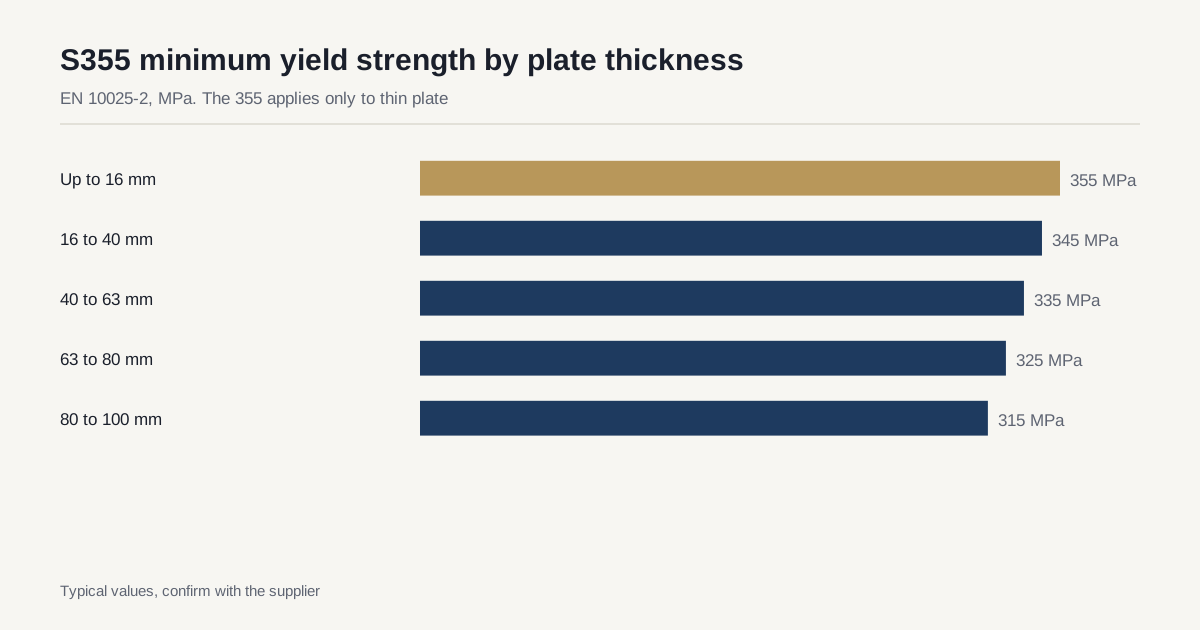
The 355 in the name applies to thin plate. EN 10025-2 lowers the minimum yield as thickness grows, because thick plate cools more slowly and ends up with a coarser microstructure:
| Plate thickness | Minimum yield strength |
|---|---|
| Up to 16 mm | 355 MPa |
| Over 16 to 40 mm | 345 MPa |
| Over 40 to 63 mm | 335 MPa |
| Over 63 to 80 mm | 325 MPa |
| Over 80 to 100 mm | 315 MPa |
Frame designs that rely on yield strength in thick plate should use the value for the actual thickness. Stiffness-driven designs are unaffected, because elastic stiffness depends on the modulus of elasticity, which is about the same for all structural steels.
Related requirements often missed
The impact grade is only one part of the material specification.
- Weldability and carbon equivalent. J2 has a lower maximum carbon limit than JR in most thickness bands, which helps welding slightly. Both still need preheat control on thick joints. See weld preheat on thick frame sections.
- Through-thickness properties. If tension loads the plate across its thickness, add a Z-grade such as Z25 under EN 10164. This reduces the risk of lamellar tearing and is independent of the J2 or JR choice.
- Delivery condition. S355 plate can be supplied as rolled, normalised or thermomechanically rolled. Normalised delivery gives a more uniform structure, covered in normalised steel plate.
- Certification. Without a mill certificate, the grade is a claim. See mill certificate types.
How to write it on the drawing
A note that works for most frames:
Plate: S355J2 (EN 10025-2) or approved equivalent with Charpy 27 J at -20 °C. Mill certificates EN 10204 type 3.1 to be supplied with the part.
For frames without a toughness need:
Plate: S355JR (EN 10025-2), Q355B or A572 Gr.50 acceptable. Mill certificates EN 10204 type 3.1 on request.
Always list acceptable equivalents so the shop can use what its supplier stocks, and state a Charpy temperature explicitly whenever toughness matters. Naming only “S355” invites the cheapest plate in the yard. The wider question of grades and their availability is covered in steel grades for machine frames.
Mixed stock and substitutions
Shops often hold both grades and may be tempted to substitute one for the other. Substituting J2 for JR is harmless to the design and usually acceptable, though it may change the price. Substituting JR for J2 is a change of specification and needs your approval. Put the rule in the purchase order: any substitution requires written agreement and a mill certificate for the substituted material. This matters most on thick plate and cold-service frames. A frame built from the wrong grade passes visual inspection, passes dimensional inspection and fails only when it is hit cold, which is the wrong time to find out.
Impact grade and the wider specification
The impact grade works together with other choices. A J2 plate that is welded with a consumable that has no impact rating, or stress relieved at the wrong temperature, loses part of its advantage. If toughness matters for the frame, check that the welding procedure uses consumables with impact values at the same temperature, and that heat treatment is limited to the cycle the plate supplier approves. The material is only one link in the chain. A toughness requirement that appears on the plate line but not on the welding line is a requirement half written.
Checklist
- Decide whether the frame sees cold, shock, thick sections or heavy restraint. If not, JR is enough.
- If any of those apply, specify J2 with a stated test temperature.
- Check the minimum yield for the actual plate thickness.
- Add a Z-grade where tension acts through the plate thickness.
- List acceptable equivalents and require mill certificates.
- Ask the partner shop what it stocks before fixing the grade on the drawing.
If you are unsure whether your frame needs J2, send the drawing with the operating environment. A reply with a recommendation and stock position comes within 24 business hours.
Have a frame drawing to price?
Send it through for a manufacturability review and a matched quote from the heavy-fabrication network. Reply within 24 business hours.