Aluminium extrusion frames versus welded steel frames
By Ryan, independent sourcing agent, Ho Chi Minh City, Vietnam
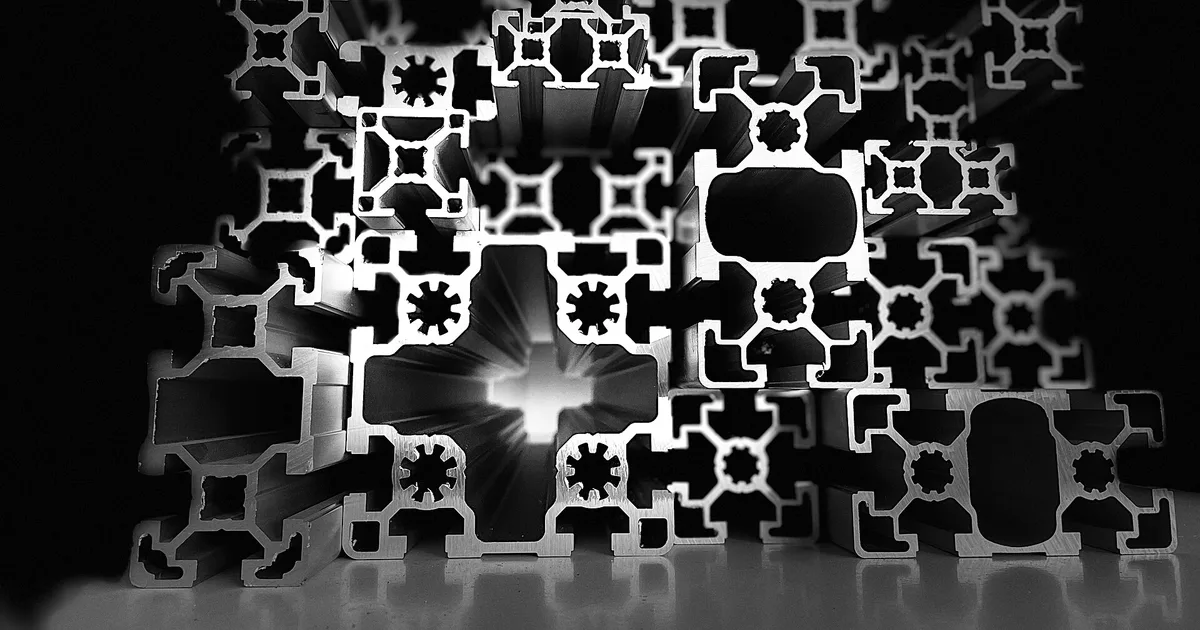
Aluminium profile systems are attractive: cut to length, bolt together with brackets, no welding, no paint, no distortion. For enclosures, guarding, assembly stations and light automation, they are a good answer and widely used. The question arises when a machine builder asks whether the same approach can carry a heavier or more precise machine, or whether it should move to welded steel.
The honest answer depends on stiffness, joint design, the loads the frame must carry and the quantity you will build. This article compares the two systems on the properties that matter for machine frames and gives practical limits for each. The material choice sits inside our guide to machine frame design.
Material properties first
Aluminium is light, but light is not the same as stiff. The relevant numbers, typical for common alloys:
| Property | Structural steel | Aluminium 6060 or 6063 |
|---|---|---|
| Density | about 7,850 kg/m³ | about 2,700 kg/m³ |
| Elastic modulus | about 210 GPa | about 70 GPa |
| Specific stiffness (modulus over density) | about 27 | about 26 |
| Thermal expansion | about 12 µm/m per K | about 23 µm/m per K |
| Typical yield strength | 235 to 355 MPa | about 150 to 200 MPa after ageing |
The specific stiffness figure is the key. Per unit of mass, aluminium and steel are about equally stiff. Aluminium saves weight only when the section can be made bigger, which is what extruders do: they spread the metal out into larger hollow profiles. For a given section size, steel is three times stiffer. For a given weight, the two can be comparable if the aluminium section is allowed to be deeper.
Thermal expansion is the other difference. Aluminium grows nearly twice as much as steel for each degree of temperature change. A 2-metre aluminium frame warms 5 degrees and grows about 0.23 mm. On a machine that must hold position to a few hundredths, that matters.
A deflection example
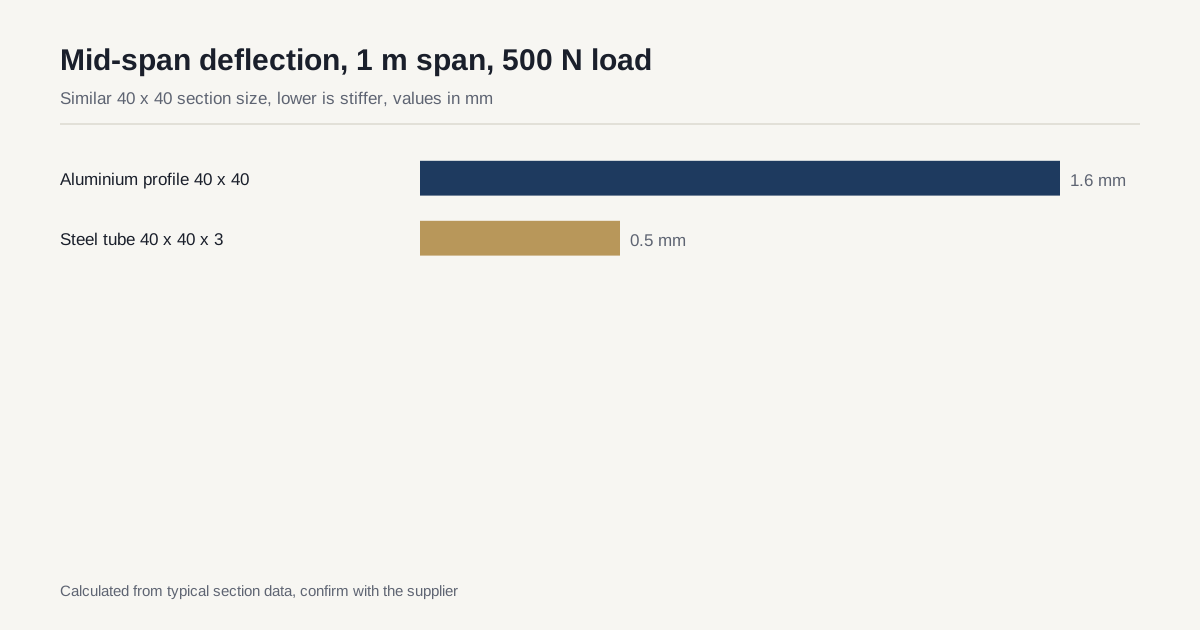
Compare a typical 40 × 40 mm light-series aluminium profile with a 40 × 40 × 3 mm steel tube. The aluminium profile has a second moment of area of about 9.5 cm⁴ and the steel tube about 10 cm⁴, so they are close in section stiffness. Place each on a 1 metre simple span with a 500 N load at mid-span.
- Aluminium: deflection ≈ P·L³ / (48·E·I) ≈ 1.6 mm.
- Steel: deflection ≈ 0.5 mm.
The profiles weigh about 1.5 kg and 3.4 kg per metre respectively. The steel is about three times stiffer and a little more than twice as heavy. To match the steel tube’s stiffness, the aluminium profile would need to be a larger or heavier series. Values are approximate, so check the supplier’s profile data for the actual section properties.
Joints decide stiffness
A welded steel frame is a continuous structure. The joints are as stiff as the members they connect, and stiffness comes from the section and the geometry.
A profile frame is a set of members connected by brackets, T-nuts and screws. Every joint is a flexible, slightly slipping connection. Joint stiffness is usually lower than the members’, so the frame deflects more than a beam calculation predicts, and the number of joints along a load path counts. Corner brackets, gusset plates and cross bracing help. Bolted joints also relax over time as vibration loosens fasteners and as the surfaces bed in.
The effect is visible in practice: frames of profile deflect and sway under side loads, and a machine that moves quickly can excite them. On the positive side, many joints add friction and damping. This is the same point discussed in bolted versus welded machine frame construction.
Damping and vibration
Welded steel has low material damping, which is why heavy frames are filled with polymer concrete or built from cast iron where vibration is critical. Aluminium extrusion has low material damping too, but its bolted joints add some. The natural frequency of a light profile frame is often low, which can clash with machine motion frequencies. Natural frequency of machine structures explains how to estimate it and what to do if it falls in a bad range.
Where each system fits
| Application | Aluminium profile | Welded steel |
|---|---|---|
| Guarding and enclosures | Preferred | Rarely needed |
| Assembly stations, test benches under 100 kg | Preferred | Suitable |
| Light automation cells | Common | Common |
| Machines with moving mass above about 100 kg | Needs careful design | Preferred |
| Precision machines with tight positioning | Rarely suitable | Preferred, usually stress relieved and machined |
| Frames exposed to heat or wash-down | Suitable if anodised | Suitable if coated or stainless |
| Prototypes and frequent changes | Strongly preferred | Slower to modify |
| Series above several hundred units | Cost rises with parts count | Preferred once fixtures exist |
The limits are indicative. A well-braced profile frame carries loads that surprise people, and a poorly designed welded frame can be less stiff than a good profile one. Design quality outweighs system choice.
Cost and lead time
Profile systems have low tooling cost and short lead time: parts are stocked, cut to length and assembled. For a single unit or a small batch, cost is competitive. Cost rises with joint count, since each bracket, T-nut and fastener adds up. A frame with 150 joints is a lot of parts to buy and assemble.
Welded steel has a higher setup cost. A fixture, programming and procedure qualification all cost money, but they amortise across a series. The per-unit cost falls as volume rises. Break-even depends on design and region, so ask for both routes to be quoted. A fixture is covered in welding fixtures for repeat production.
Precision features still need machining
Neither system gives precision mounting surfaces for free. Profile frames let you bolt machined plates onto the structure and align them. Welded frames are usually machined after stress relief. Either way, the mounting surface for linear guides or a spindle is usually a separate machined plate or a machined face, not the raw frame member. Plan the machining step in the design.
Hybrid designs
Many machines combine the two. A welded steel base carries the precision axes and the heavy mass, while an aluminium profile superstructure holds guards, panels, cable trays and light fixtures. The interface is a machined plate on the steel base with threaded holes for the profile feet. This uses each material where it is strong: steel for stiffness and damping at the base, aluminium for speed of build and easy modification on top.
Fasteners and maintenance
Profile frames need maintenance that welded frames do not. Fasteners relax, T-nuts can slip and brackets can loosen with vibration, so a maintenance plan should include periodic checks and retightening to a stated torque. Thread-locking compounds and serrated washers reduce but do not remove the effect. If the machine will run unattended for months, a welded joint is more reliable, because there is nothing to loosen. If the machine is accessible and moved often, the ease of adjusting a profile frame may outweigh the maintenance.
Choosing between the two at quote stage
If you cannot decide, ask for both. A partner shop can quote a welded steel version and a profile version of the same frame, and the comparison will include cost, lead time and the shop’s own view of stiffness. Provide the load case, the accuracy target and the quantity, because those three numbers decide most of the answer. If the quotes land close together, prefer the system that suits your assembly line and your service team. If they differ widely, the cheaper one may be hiding a requirement that the other has priced.
Checklist
- Estimate stiffness from the actual profile data, and add joint flexibility to the calculation.
- Check expected natural frequency against machine motion frequencies.
- Allow for thermal expansion if the structure sees temperature swings.
- Use profile systems for guards, enclosures and light stations; use welded steel for moving mass and precision.
- Compare quoted cost at your actual quantity and include assembly time.
- Plan machining of mounting faces regardless of the system.
If you are unsure which route fits your machine, send the layout and load data and the network will respond with options within 24 business hours.
See also: aluminium profile standards for machine frames, EN 755 and EN 12020.
Have a frame drawing to price?
Send it through for a manufacturability review and a matched quote from the heavy-fabrication network. Reply within 24 business hours.