Frames for semiconductor and inspection equipment
By Ryan, independent sourcing agent, Ho Chi Minh City, Vietnam
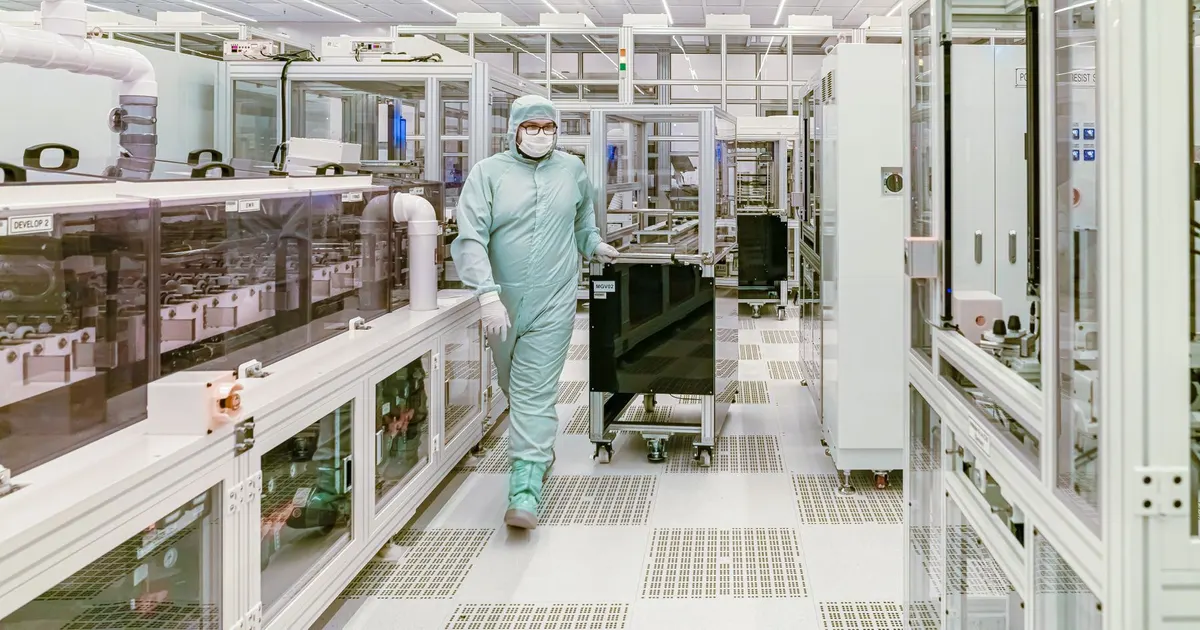
A tool that inspects wafers or measures features on a chip does its work at the scale of nanometres. The frame that carries it is welded from steel tube and plate, sits on the floor of a cleanroom and is judged by two questions: does it move, and does it shed anything. The first is a question of stiffness and vibration. The second is a question of surface finish, weld quality and cleanliness.
Equipment makers in this field often need frames in small and medium quantities, built to tight dimensional and cleanliness requirements. This article describes what these frames do, how vibration and stiffness targets translate into design choices, what the cleanroom adds to welding and finishing and what a fabrication drawing should state.
What the frame does
In a typical inspection or metrology tool, a welded frame has several jobs.
Carry the precision core. A granite or polymer-concrete base, or a machined plate, holds the stage and optics. The frame supports that base and the covers, electronics and utilities around it.
Isolate from the floor. Cleanroom floors carry vibration from air handlers, pumps and foot traffic. Isolators, commonly air mounts with natural frequencies of 1 to 3 Hz, sit between the floor and the tool. The frame is often built around the isolator mounting points.
Provide a rigid, repeatable mounting for modules. Load ports, robot handlers, chambers and process modules bolt to the frame. Their positions relative to each other set how well the tool works in the production line.
Protect. Covers, panels and enclosures hang off the frame and must close without gaps.
Stiffness and vibration
Isolation works only when the structure on the isolators is stiff compared with the isolator. The isolator’s natural frequency is about 1 to 3 Hz, and the frame’s lowest natural frequency should sit much higher, often 50 to 100 Hz or more depending on the tool. A frame whose natural frequency sits in the 20 to 40 Hz range can be excited by floor vibration or by the machine’s own motion and amplify it.
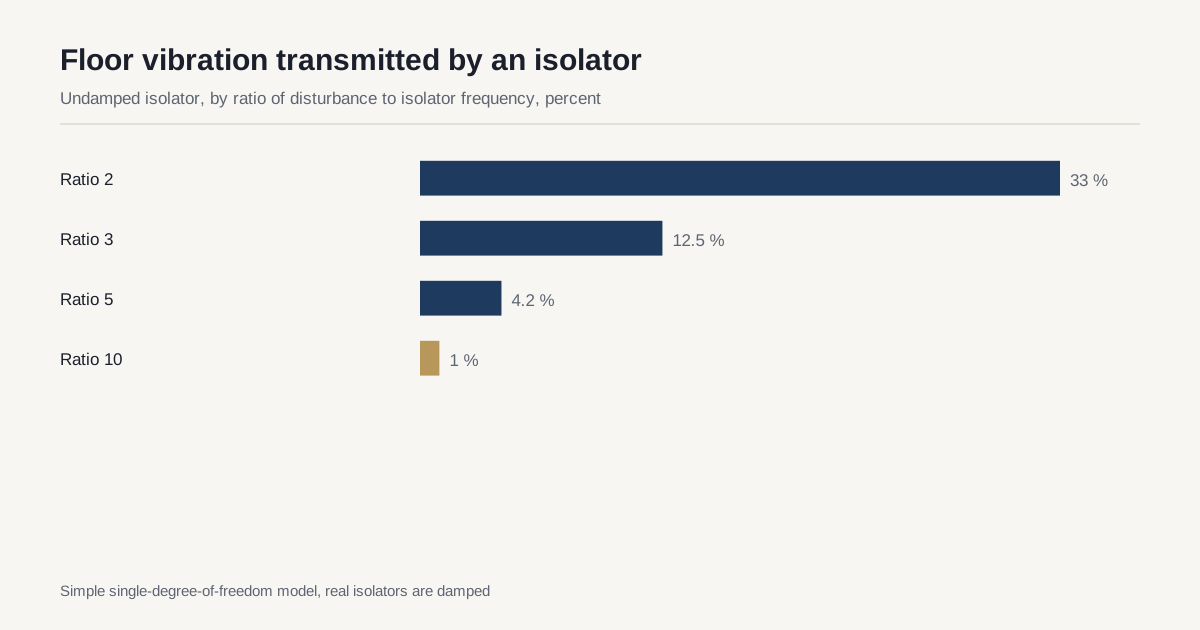
Isolators reduce vibration only above a certain frequency ratio. For a simple undamped isolator, the transmitted fraction of floor vibration at different ratios of disturbance frequency to isolator natural frequency looks like this:
| Frequency ratio | Transmitted vibration |
|---|---|
| 2 | about 33 percent |
| 3 | about 12 percent |
| 5 | about 4 percent |
| 10 | about 1 percent |
Real isolators have damping, which reduces transmission near resonance and raises it slightly at high ratios. The table shows why low-frequency isolation is attractive and why the frame above must not have its own modes in the range where isolation is weak. The basics of estimating frame frequency are in natural frequency of machine structures.
Practical steps that raise frame frequency:
- Use closed sections, tube or box, for torsional stiffness. See square tube or I-beam for light frames.
- Keep spans short and add bracing in two directions.
- Use gusseted or fully welded joints instead of bolted ones at the main nodes.
- Minimise the mass hung on long unsupported arms.
Welded steel has low internal damping. Some designs add damping with constrained-layer treatments or with a sand or polymer fill in hollow sections, but those choices complicate cleaning and are decided with the machine designer.
Cleanroom requirements for a frame
A frame in a cleanroom is not product-contact, but it sits in air that is controlled to a particle class under ISO 14644-1. It must not become a source of particles, and it must be cleanable.
| Requirement | Frame response |
|---|---|
| No flaking coatings | Stainless steel, electropolished or passivated, or a durable powder coat applied to specification |
| No trapped particles or liquid | Sealed hollow sections, continuous welds, no open crevices |
| Smooth cleanable surface | Ground weld beads, finish defined by zone, no porosity |
| Low corrosion risk | Stainless 304 or 316L, or coated carbon steel with sealed edges |
| Electrostatic control | Grounding points, conductive coating where specified |
| Magnetic properties | Austenitic stainless is mostly non-magnetic; confirm if magnetic fields matter |
Carbon steel frames are common for the hidden parts of the tool, as they are cheaper and stiffer, with coating sealed against flaking. Visible and wet-zone parts are usually stainless. The hygienic design rules in packaging machine frames in stainless apply here as well: slope, seal and weld continuously.
Welding stainless for the cleanroom. TIG welding with back purge keeps the inside of tubes free of oxide. Welds are ground and blended, then the part is pickled and passivated or electropolished. Dedicated stainless tools prevent iron contamination.
Venting. A sealed hollow section that is welded closed traps air. When heated, it expands and can distort. On vacuum or high-purity tools, trapped gas in a hidden crevice is a source of slow contamination. Provide small vent holes where the design calls for them, positioned where they do not open into the clean area.
Tolerances and datum structure
Module mounting faces on these frames are typically machined after welding to flatness and position tolerances in the range of 0.05 to 0.2 mm, tighter on precision interfaces. Position tolerances between module faces are set from a datum structure on the frame. Define it on the drawing. See GD&T datum strategy for weldments for guidance.
Dimensional reports should come from a coordinate method such as a CMM or laser tracker, with datum-based alignment. The principles in dimensional reports on weldments apply directly. Stress relief before final machining is normal for frames with tight interface tolerances.
Quantity and change control
Equipment frames are often built in small batches with frequent revisions. A modular fixture and a clear revision process save time. Agree early:
- Who owns the fixtures and how they are stored.
- How revisions are communicated and when they take effect.
- How the first article is approved before the batch.
The routine of first-article approval is described in first article inspection for large weldments.
Export and end-use notes
Semiconductor tooling can fall under export control rules depending on the process node, destination and application. This site works with civil industrial equipment and declines defence-related parts. If your frame supports a tool with export-controlled content, state the classification in your RFQ so it can be handled properly. The network can only quote parts for which export-control conditions are clear.
What to put on the drawing
- Material and grade by region, with mill certificates.
- Weld type and finish: continuous, ground flush in clean zones, sealed hollow sections.
- Surface treatment: pickle and passivate, electropolish or powder coat, with a specification.
- Interface features: datums, flatness, position tolerances.
- Isolator mounting positions and load rating.
- Vent holes, drain holes, grounding points.
- Cleaning and packing: wipe-down, double bagging or cleanroom packaging if required.
Cleaning, packing and handling
A clean frame can be recontaminated in minutes by handling and packing. Agree how the frame will be cleaned after fabrication, for example with a detergent wash and a wipe, and how it will be packed, for example in two layers of cleanroom-grade film with protective caps on threaded holes. Gloves and clean tools for handling are part of the process, not an extra. State the cleanliness expectation in the purchase order, along with the method of verifying it, such as a wipe test or a visual inspection under light. A frame that arrives wrapped and labelled to those requirements saves time at the customer’s goods-in door.
Checklist
- Set a frame natural frequency target well above the isolator frequency.
- Choose closed sections and welded nodes for stiffness.
- Specify cleanroom finish and weld quality by zone.
- Define datums and machine interface faces after stress relief.
- State vent, drain and grounding requirements.
- Declare any export-control classification.
- Agree a first-article and revision procedure.
To review a frame drawing for cleanroom and stiffness requirements before it goes to quote, send it through. The network replies within 24 business hours.
See also: SEMI S2 and S8, the areas that reach the frame.
Have a frame drawing to price?
Send it through for a manufacturability review and a matched quote from the heavy-fabrication network. Reply within 24 business hours.