Packaging machine frames: stainless, washdown and hygiene
By Ryan, independent sourcing agent, Ho Chi Minh City, Vietnam
A packaging machine frame that is built like any other welded base will work on day one and cause trouble on day ninety. Food, drink, pharmaceutical and personal-care lines are cleaned with water, detergent and sometimes hot or chemical washes, often at the end of every shift. Anything that traps liquid or product, such as a flat ledge, an open hollow section or a crevice, becomes a hygiene problem and a corrosion site.
This article is for machine builders who source stainless frames for packaging equipment. It covers grade choice, hygienic design rules that affect the frame, welding and surface finishing requirements and what to specify on the drawing.
Choose the grade for the cleaning regime
Two austenitic stainless steels cover most frames.
304 (EN 1.4301) is the general-purpose grade. It resists food acids, water and mild cleaning agents. It is cheaper than 316 and widely stocked.
316 (EN 1.4401 or 1.4404) contains molybdenum, which improves resistance to chlorides. Choose it where the frame sees salt, brine, chlorinated cleaners or sanitisers or humid coastal air. Many washdown environments justify 316 for splash-zone parts and 304 elsewhere.
| Property | Carbon steel S355 | Stainless 304 | Stainless 316 |
|---|---|---|---|
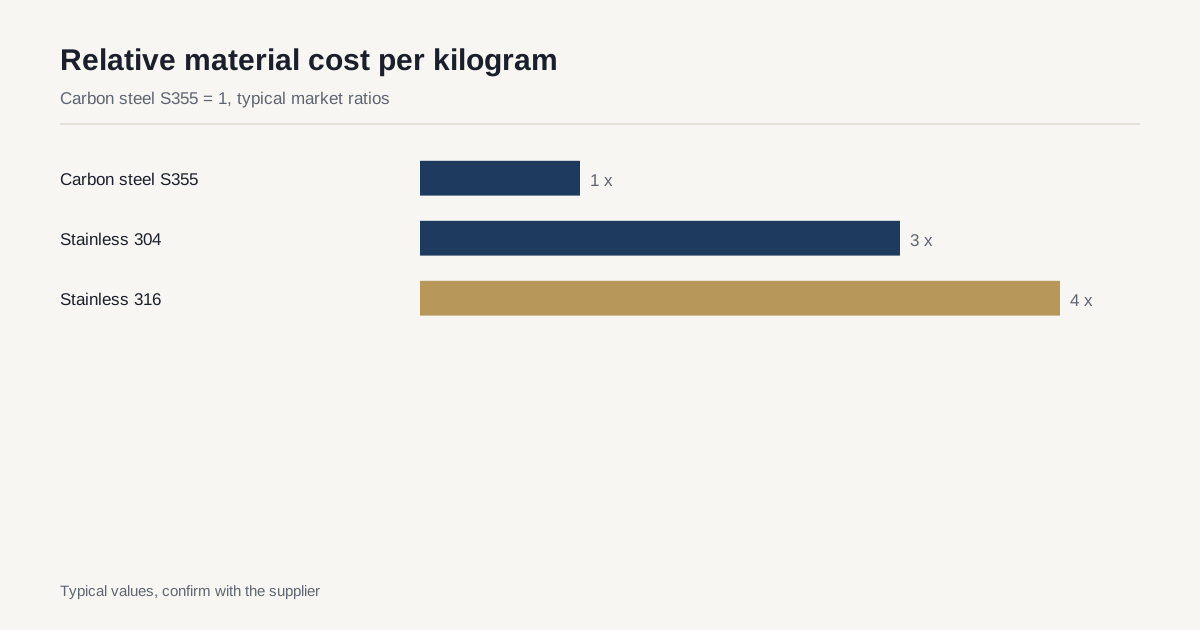
| Relative cost per kg | 1 | about 3 | about 4 |
| Corrosion resistance | Needs coating | Good | Better against chlorides |
| Thermal expansion | about 12 µm/m·K | about 17 µm/m·K | about 16 µm/m·K |
| Thermal conductivity | about 50 W/m·K | about 15 W/m·K | about 15 W/m·K |
| Distortion when welded | Moderate | Higher | Higher |
The cost ratios are typical and move with market prices. Stainless expands more and conducts heat less than carbon steel, so welding heat stays local and distortion is worse. Weld planning matters more, which links back to controlling distortion on large weldments.
Hygienic design rules that shape the frame
Standards and guidelines such as ISO 14159, EN 1672-2 and the EHEDG guidelines describe hygienic design for food-contact and food-area equipment. Frames fall in the non-product-contact category, but they sit next to product and take the same cleaning. The following rules recur.
Slope, do not shelf. Horizontal flat surfaces hold liquid. Use sloped surfaces, with a slope of a few degrees as a minimum, for tops of boxes and ledges, or use round and angled sections that shed water. Hollow sections laid on their corners (diamond orientation) are common.
Use radiused corners. Internal corners where two surfaces meet should have a radius, commonly 3 mm or more, so cleaning can reach them. Sharp internal corners hold dirt.
Seal hollow sections. An open tube end lets liquid in, and trapped liquid cannot be cleaned. Either seal tubes with welded end caps and continuous welds, or avoid hollow sections in washdown zones. Never rely on a drilled vent in a food-contact area. If thermal expansion during welding is a concern, discuss venting with the shop before finalising the design.
Use continuous welds. Intermittent welds leave crevices between beads where bacteria and chemicals collect. Welds in hygienic areas should be continuous, smooth and free of undercut and porosity. This differs from structural frames, where intermittent welds save heat; the cleaning requirement takes priority.
Avoid crevices and pockets. Overlapping plates, threaded blind holes and tight gaps between parts are crevices. Where parts must bolt together, use sealing washers, hygienic fasteners with domed heads and gaskets. Prefer welded connections to bolted ones in the splash zone.
Keep the feet clean. Feet should be sealed at the machine side, with a smooth, sloped base, and leave enough space under the machine for cleaning. Floor-standing frames need clearance, commonly 150 mm or more, for cleaning tools to reach underneath.
Surface finish
Surface roughness affects cleanability. Product-contact surfaces in food equipment are often held to a roughness average (Ra) of 0.8 µm or better. Non-product surfaces such as frames commonly allow a rougher finish, in the range of 1.6 to 3.2 µm depending on the zone and customer specification. A bright polished frame costs more and is rarely needed. The usual compromise is a brushed or bead-blasted finish in non-contact zones and a polished finish where the customer’s hygiene standard requires it.
Welds must be ground and blended so that the weld surface matches the adjacent finish. A rough weld bead is a cleaning problem and a corrosion risk.
Welding stainless for corrosion resistance
Stainless steel resists corrosion because of a thin passive chromium oxide layer. Welding heat damages it, and the heat tint, the coloured oxide near the weld, is a sign that the layer is compromised.
- Process. TIG (GTAW) is common for thin sections, and MIG/MAG with an appropriate gas for thicker parts. Pulse settings reduce heat input.
- Back purging. On tube and closed sections, an inert gas purge inside the joint prevents oxidation (sugaring) on the root side. Without it, the inside of a welded tube can be rough and corrosive.
- Filler metal. Match the grade, for example 308L filler for 304 and 316L filler for 316.
- Dedicated tools. Brushes, grinding discs and clamps used on carbon steel leave iron particles that rust on stainless. Shops should use stainless-only tools or have separate areas for each material.
After fabrication, the surface is restored by pickling to remove heat tint and oxide layers, and passivation to rebuild the protective layer. Standards such as ASTM A967 describe passivation tests and treatments. A shop that welds stainless regularly should have a procedure for it. Ask what it is.
What to put on the drawing
A concise set of notes covers most requirements:
- Material: stainless steel 1.4301 (304) or 1.4404 (316L), by location, with mill certificates as described in mill certificate types.
- Welds: continuous, ground flush where marked, with a stated quality level.
- Hollow sections: sealed by welded end caps, with a marked list of exceptions.
- Surface finish by zone, with an Ra value or a descriptive standard such as brushed or bead blasted.
- Post-weld cleaning: pickling and passivation per a named specification.
- Marking of hygienic zones on the drawing, so a shop does not guess.
- Fasteners and feet: material, type and sealing method.
Weld symbols for these requirements are explained in weld symbols for machine frame drawings.
Common problems in quotes
- A quote that assumes intermittent welds on a hygienic frame. Ask for continuous welds priced explicitly.
- A quote that does not mention pickling and passivation. Ask whether it is included.
- A quote on 304 where the cleaning chemicals call for 316.
- A frame drawn from carbon steel details that needs redesign for washdown. The shop can flag this, and good shops do.
Fasteners, feet and accessories
Frame details outside the welds often decide hygiene. Use stainless fasteners of the same family as the frame, since mixing carbon steel bolts with stainless invites rust stains and galvanic effects. Prefer hygienic fasteners with sealing washers, and avoid slotted heads and socket heads in washdown zones, which trap residue. Feet should be stainless with a sealed, sloped base and a smooth transition to the frame. Cable and pipe supports need a gap from the frame wall so that cleaning reaches behind them. These small parts are easy to forget on a drawing and expensive to retrofit.
Testing the weld and finish
A visual check shows whether a stainless weld is smooth and free of heat tint, but it does not show everything. Penetrant testing finds surface cracks and pinholes that would trap residue. A passivation test, such as a water immersion or copper sulphate test described in the relevant standard, shows whether free iron remains on the surface. For hygienic zones, ask the shop which checks it runs and what the acceptance criterion is. A shop that can name its test method and show a sample record has done this work before.
Checklist
- Choose 304 or 316 by cleaning chemicals and environment.
- Design sloped surfaces, radiused corners and sealed hollow sections.
- Specify continuous welds in hygienic zones.
- State finish by zone and weld blending.
- Require pickling and passivation and ask how it is verified.
- Use dedicated stainless tools and storage.
- Check the frame against ISO 14159 or the customer’s hygiene standard.
To see how partner shops would approach a hygienic stainless frame, send the drawing and the cleaning regime. The network replies within 24 business hours.
See also: hygienic design of machine frames, the standards map.
See also: stainless frame welding, AWS D1.6 and heat tint acceptance.
Have a frame drawing to price?
Send it through for a manufacturability review and a matched quote from the heavy-fabrication network. Reply within 24 business hours.