Weld preheat and interpass temperature on thick frame sections
By Ryan, independent sourcing agent, Ho Chi Minh City, Vietnam
A frame can pass visual inspection, pass dimensional inspection and still contain a crack that has not yet shown itself. The usual culprit on thick structural steel is hydrogen cracking, and the usual prevention is something that costs very little: warming the plate before welding and keeping it warm between passes.
Preheat is easy to overlook because it is invisible in the finished part. A drawing that says nothing about it leaves the decision to the shop, and a shop quoting on price may be tempted to skip it on a joint where cracking is unlikely but not impossible. Knowing the basics lets you ask the right questions and read the answers.
What preheat does
When a weld cools, the heat flows into the surrounding plate. Thick plate is a large heat sink, so the weld and the narrow zone beside it cool fast. Fast cooling in a medium-carbon steel forms a hard, brittle microstructure in the heat-affected zone. If hydrogen is present, from moisture, oil or the welding consumable, it diffuses into that zone and, under the stress of a restrained joint, can open a crack hours or days after welding.
Preheat slows the cooling rate. A slower cool lets a tougher microstructure form and gives hydrogen time to diffuse out of the joint. Interpass temperature, the temperature of the plate when the next pass starts, keeps that benefit going through a multi-pass weld. A maximum interpass temperature also matters because too much accumulated heat can soften the heat-affected zone or reduce toughness.
What sets the preheat temperature
Four things drive the number a welding procedure specifies.
Steel composition. The carbon equivalent value (CEV) condenses the effect of carbon and alloying elements on hardenability. A common form is the IIW formula: carbon plus manganese over 6 plus chromium, molybdenum and vanadium over 5 plus nickel and copper over 15. A higher value means the steel hardens more easily and needs more preheat. Mill certificates give the chemistry. The grade question is covered in S355J2 or S355JR and in steel grades for machine frames.
Combined thickness. The more steel around the joint, the faster it cools. Standards use the combined thickness of the plates meeting at the joint, so a T-joint of two 40 mm plates behaves like an 80 mm section.
Hydrogen level of the consumable. Low-hydrogen electrodes, flux and wire permit lower preheat. That only works if they are kept dry. Electrodes come out of a heated oven and flux is stored dry. A shop that leaves flux open to humid air has lost the benefit.
Restraint and heat input. A rigid frame restrains the joint and raises the stress on it. Low heat input, such as a small bead at a fast travel speed, cools faster and may need more preheat than a larger bead.
Typical values for frame plate
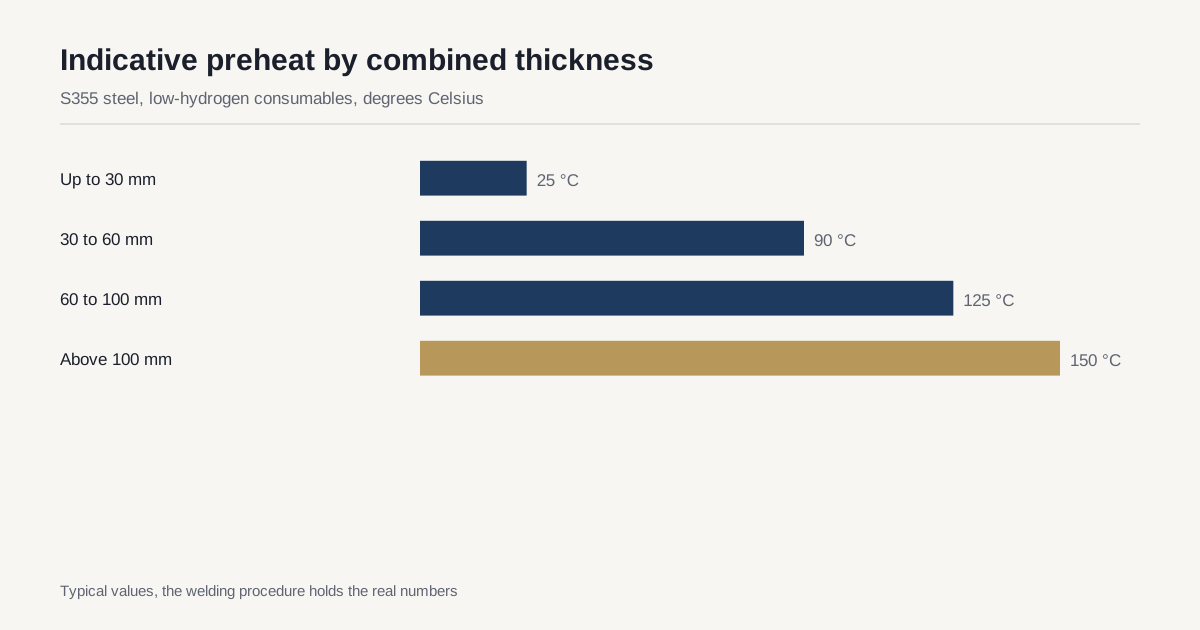
Procedure standards such as EN 1011-2 and the AWS D1.1 prequalified tables give the formal method. The following table shows indicative ranges for S355 structural steel with low-hydrogen consumables, to give a sense of scale.
| Combined thickness | Indicative preheat | Notes |
|---|---|---|
| Up to about 30 mm | None to 50 °C | Warm the joint if the plate is cold or damp |
| 30 to 60 mm | 75 to 100 °C | Typical for T-joints on base plates |
| 60 to 100 mm | 100 to 150 °C | Heavier sections, restrained joints |
| Above 100 mm | 150 °C and up | Procedure qualification usually required |
Interpass limits of around 250 °C are common for this steel family. These are typical values, not requirements for your frame. The welding procedure specification for your joint holds the real numbers.
How the temperature is checked
A temperature that is stated and a temperature that is measured are different things. Practical methods include:
- Temperature-indicating crayons that melt at a set temperature. Cheap, quick and widely used.
- Contact pyrometers or surface thermometers that read the plate directly.
- Thermocouples attached to the plate for critical or large joints, sometimes with a chart record.
The measurement location matters. Standards typically require the temperature to be reached across a band either side of the joint, often 75 mm or a multiple of plate thickness, and measured on the face opposite the heat source or after a soak time so that the whole thickness is warm. Heating the surface with a torch and welding at once leaves the core of the plate cold. Ask how the shop measures and where.
Heating methods
Shops use whichever method suits the joint:
- Gas torches, including ring burners and rosebud tips, for general work. Fast and flexible, but local overheating is possible and a torch can leave moisture condensation on cold plate.
- Electric resistance heating mats that wrap around a joint and hold a steady temperature. Good for long interpass holds and for stress relief setups.
- Induction heating for production, repeatable preheat on heavy sections.
On large frames the preheat region can be several metres of seam, so heating method affects both labour time and schedule. A shop that knows its preheat cost will say so at quote.
After the weld
Cooling slowly matters too. Covering a thick weld with an insulating blanket keeps it warm and lets hydrogen escape. On the thickest, most restrained joints a procedure may call for a hydrogen bake, typically holding the joint at 200 to 300 °C for a few hours straight after welding. This is not routine on frames up to 60 mm but appears on heavy sections. Post-weld heat treatment for stress relief is a separate step; see stress relieving welded machine bases.
What to put on the drawing and in the RFQ
You do not need to specify the temperature yourself. You need to make sure the shop has one. Useful requirements:
- Welding procedure specifications issued under a recognised standard (ISO 15614-1, AWS D1.1 or equivalent), with preheat and maximum interpass stated.
- Low-hydrogen consumables, kept dry per the manufacturer’s instructions.
- Mill certificates giving chemistry for the plate, so the carbon equivalent can be checked. Mill certificate types explains what each type contains.
- A record of preheat and interpass checks for joints above a stated thickness, kept with the inspection file.
A shop that gives you the WPS number and an example of its preheat record has done this before.
Cold plate and humid air
Ambient conditions change the preheat picture. In a cold workshop, plate can sit well below the temperature at which welding is sensible, and a thin sheet of condensation can form when a cold plate meets warm humid air. In a warm and humid workshop the issue is moisture on the plate surface and in consumables. Either way, the joint should be dry and warm to the touch of the specified temperature before the arc starts. Large plates stored outside overnight need time to come up to temperature throughout, since a plate that feels warm on the surface can be cold in the core. A shop that records plate temperature at the start of each shift is showing good control.
What a good record looks like
A preheat record does not have to be elaborate. A sheet that lists the joint, the date, the required temperature, the measured temperature, the method and the initials of the welder or inspector is enough for most frames. For critical joints, attach a thermocouple chart. The record is useful in two ways: it shows that the procedure was followed, and it gives the shop evidence when a customer or auditor asks. A shop that keeps these sheets as a habit usually follows the procedure as a habit too.
Checklist
- Ask for the WPS reference on each thick joint and confirm preheat and interpass limits are on it.
- Confirm consumables are low-hydrogen and stored dry.
- Check the combined thickness on the drawing, not just the plate thickness.
- Ask how temperature is measured, where and how long the plate soaks.
- For heavy sections ask whether a hydrogen bake is planned.
- Keep the temperature record with the other inspection documents.
If a frame drawing includes plate above 40 mm, send it with your inspection expectations and the network will answer with preheat and procedure details inside 24 business hours.
Have a frame drawing to price?
Send it through for a manufacturability review and a matched quote from the heavy-fabrication network. Reply within 24 business hours.