Frames for fibre laser cutting machines: heat, speed and stiffness
By Ryan, independent sourcing agent, Ho Chi Minh City, Vietnam
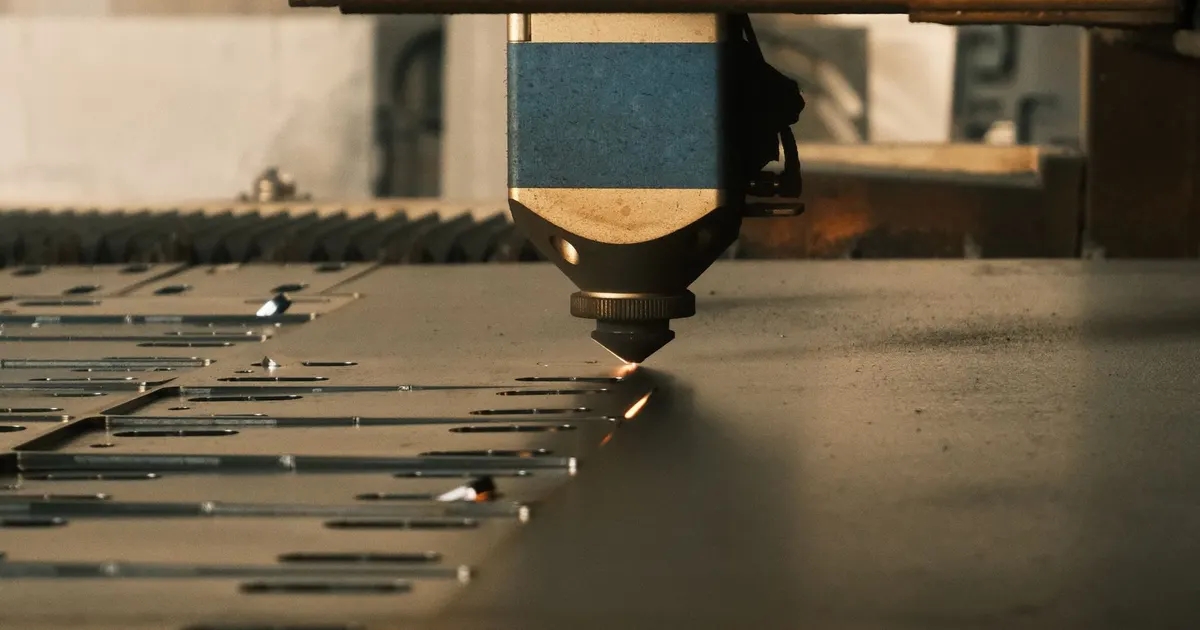
A laser cutting machine is judged by the quality of the edge it cuts and the speed at which it cuts it. Both depend on a structure that most buyers never see: the welded bed and gantry that carry the cutting head. If the frame bows, rattles or drifts with temperature, no amount of control software recovers the loss.
For machine builders who design laser cutters and source frames from outside, the frame is a tradeoff between stiffness, mass, thermal behaviour and cost. This article describes the loads and conditions a laser machine frame sees, how designs usually divide into bed and gantry and what a drawing should specify so that partner shops quote the same part.
What the frame has to do
Five demands act on the structure together.
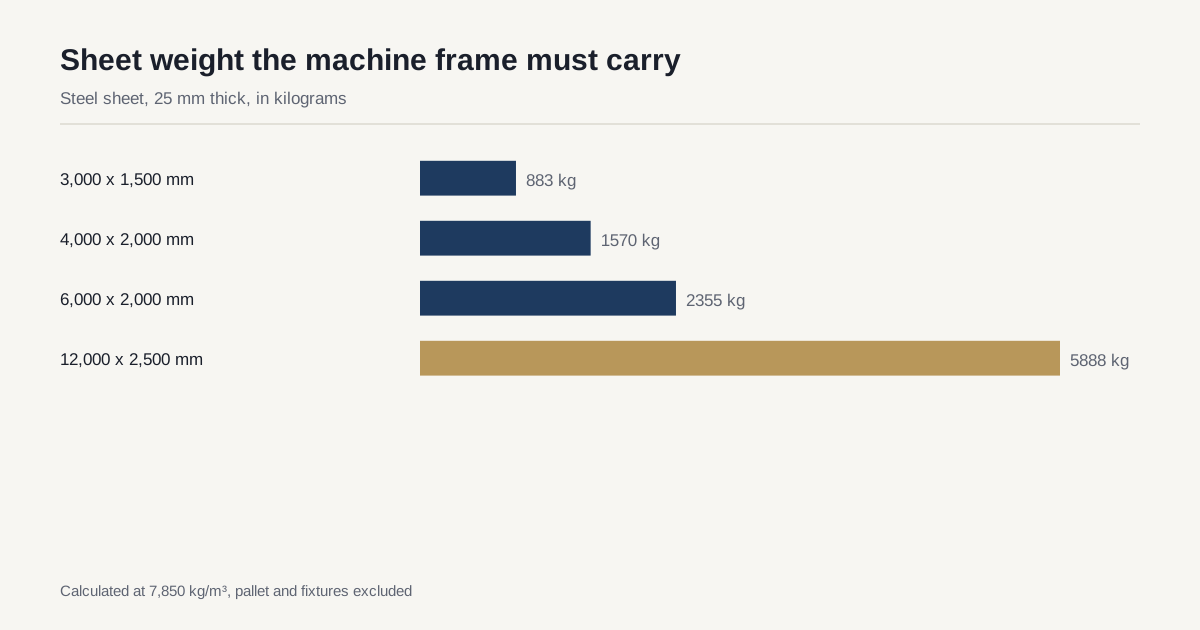
Carry the sheet. A full sheet is heavy, and the bed or pallet carries it. At 25 mm thickness, a 3,000 × 1,500 mm sheet of steel weighs about 880 kg, a 6,000 × 2,000 mm sheet about 2,350 kg and a 12,000 × 2,500 mm sheet nearly 5,900 kg. On machines with a pallet changer the frame also carries the second pallet and the loading forces. Static deflection of the bed under that load changes the working height of the cutting head above the sheet.
Hold rail geometry. Linear rails or racks on the bed set the straightness of travel. Rail mounting surfaces are typically machined flat and straight to a few hundredths of a millimetre over a metre, and they must stay that way. See frame flatness and squareness checks for how that is verified.
Resist acceleration. Cutting thin sheet involves fast motion with high accelerations, often in the range of 1 to 2 g, while the head traces small features. Each acceleration pushes reaction forces into the frame, and a low natural frequency makes the structure ring and leave visible wave marks on the cut edge. The theory of avoiding this is in natural frequency of machine structures.
Stay stable with temperature. The cut puts heat into the sheet and the bed. A laser source, chiller and extraction equipment add heat in the workshop. Steel grows about 12 micrometres per metre per degree, so a 6-metre bed warming by 5 degrees grows about 0.36 mm. Most machines tolerate this through software compensation, but a frame with strong thermal gradients behaves less predictably.
Survive hot slag, dust and fumes. Falling slag and dust settle in the bed and extraction channels. Frames need openings for fume extraction, drainage for slag and sealed sections where chips and dust could collect.
Typical frame layout
| Element | Common construction | Key requirement |
|---|---|---|
| Machine bed | Welded steel box frame, ribbed, stress relieved, machined rail faces | Rail flatness and straightness, stiffness under sheet load |
| Cutting table or pallet | Welded frame with replaceable slats | Weight capacity, easy slat replacement, flatness within tens of millimetres, not hundredths |
| Gantry or cross beam | Aluminium extrusion or cast, or welded steel box | Low mass for fast acceleration, high stiffness |
| End carriages and uprights | Welded or cast steel, machined seats | Bearing alignment, squareness to bed |
| Extraction channels and enclosure | Sheet metal, welded | Sealing, access, fire resistance |
| Support frame and feet | Steel, adjustable | Even load transfer, levelling |
Not every machine uses every element, and the split between welded steel and other materials changes with the builder’s philosophy. Some builders use welded steel throughout, others use a steel bed with a light gantry in aluminium. Comparisons of steel with alternatives appear in aluminium extrusion versus welded steel frames and cast iron versus welded steel bases.
Bed design points
Box-section construction. Closed boxes with internal ribs resist bending and twisting. The ribs set the stiffness, and their layout deserves more attention than the plate thickness. Our note on rib design for machine frames goes into spacing and thickness.
Stress relief. A bed several metres long, machined after welding, needs stress relief first, or it moves as it relaxes in service. The process is discussed in stress relieving welded machine bases. A bed longer than the shop’s furnace is a special case: vibratory methods or sectional construction may be used, and the shop should say which.
Sectional beds. Beds beyond about 6 to 8 metres are often built in sections that bolt together and are aligned with a laser tracker. Joint design and dowelling matter, and the assembly sequence belongs in the machine builder’s procedure.
Rail seats. The pads where rails mount are machined in one setup from a common datum, so that both rails are parallel to each other and to the bed. Machining the pads on a boring mill or gantry mill is the norm. See machining large weldments.
Gantry design points
Gantry mass sets how fast the machine can accelerate. A heavy steel gantry is stiff but limits dynamics. A light gantry made of aluminium or a thin-walled welded steel box accelerates faster but may be less stiff. The common compromise is a hollow beam with internal diaphragms, sized for natural frequency, and a lightweight head carriage. If your gantry is welded steel, plan welds to control distortion on a long beam, using the levers in controlling distortion on large weldments.
What to put on the drawing
- Flatness and straightness of rail pads, with a datum and a measurement method.
- Parallelism between the two rail lines and squareness of the gantry seats.
- Material and delivery condition. Normalised plate is worth considering for a bed with large machined faces.
- Stress relief requirement, with a record of the temperature cycle.
- Surface treatment: paint system, oil on machined faces, rust prevention for shipping.
- Inspection report format: laser tracker or CMM data with datum-based alignment.
- Interfaces: bolt patterns for sections, mounting for extraction, cable trays and enclosure panels.
Tolerance budget
The cutting accuracy the end customer sees is a stack of errors from the frame, the guides, the drives and the control. Allocate the frame a share of the budget. If the machine positioning target is ±0.05 mm over its length, a bed whose rail faces are out by 0.1 mm leaves nothing for anything else. The method for allocating errors is in machine frame tolerance stack-up.
Transport and installation
Large laser machine frames are shipped in sections and reassembled on site. Plan this early. Section joints need locating features such as dowels or keyed faces, and the assembly procedure should state bolt torque and the order of tightening. After installation the machine builder levels the bed, aligns the rails and calibrates the axes, often with a laser interferometer. A frame that arrives with clean machined faces, protected against rust and packed on supports that preserve its geometry, saves days of commissioning time.
Lead time and series planning
A laser machine builder usually orders frames in batches that follow the assembly schedule. Share the build plan with the frame supplier so that stress relief furnace time and machining slots can be booked in advance, since both are bottlenecks for large beds. A frame ordered with a few weeks’ notice can wait for a free slot. A frame that is needed next week cannot. If the machine design is stable, a scheduled release agreement with fixed monthly quantities helps the shop plan material and gives the builder a predictable supply.
Checklist
- Calculate the maximum sheet and pallet load, then size the bed for deflection, not just strength.
- Set a target natural frequency for bed and gantry before choosing sections.
- Specify rail pad flatness, straightness and parallelism with datums.
- Require stress relief before final machining on every welded bed.
- Plan sectional construction and alignment for long machines.
- Define heat, slag and fume provisions in the frame design.
- Agree the inspection record format with the frame supplier.
To get the frame quoted by partner shops with comparable assumptions, send the drawing with load and accuracy targets. The network replies within 24 business hours.
Have a frame drawing to price?
Send it through for a manufacturability review and a matched quote from the heavy-fabrication network. Reply within 24 business hours.