Gantry frames for large-format CNC routers
By Ryan, independent sourcing agent, Ho Chi Minh City, Vietnam
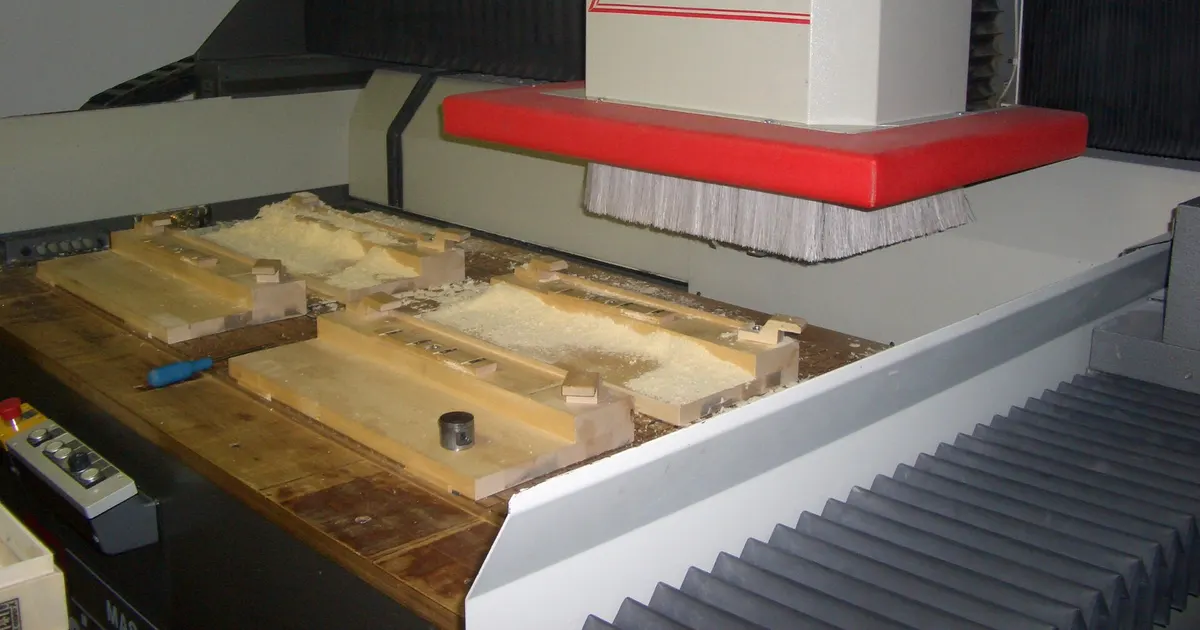
A large-format CNC router looks simple: a flat table, a bridge across it and a spindle that moves in three axes. The frame under that simplicity decides whether the machine cuts a 2.5 metre panel square and flat or produces parts that are slightly diamond-shaped and slightly dished. Spindle and controller quality matter, but a weak frame sets the ceiling.
Machine builders who source welded gantry and bed frames need to translate a performance target into fabrication requirements. This article explains the structure of a gantry router, where stiffness comes from, which tolerances matter and what to include in the drawing and RFQ.
The structure in three parts
The bed or base. A long, rigid frame carries the table and the two rails on which the gantry travels. It is typically a welded steel box structure, ribbed internally, with a top surface machined for the rails. Its job is to keep the rails straight, parallel and level under the weight of the gantry and workpiece.
The gantry. Two uprights, called legs or side frames, carry a cross beam. The legs ride on the rails and the beam carries the spindle carriage along the X or Y axis. The gantry spans the full table width, so beam length is typically two to four metres on production machines.
The table. A vacuum or T-slot table holds the workpiece. It may be part of the base structure or a separate welded or aluminium assembly bolted to the base. Table flatness controls cut depth consistency.
Where gantry stiffness comes from
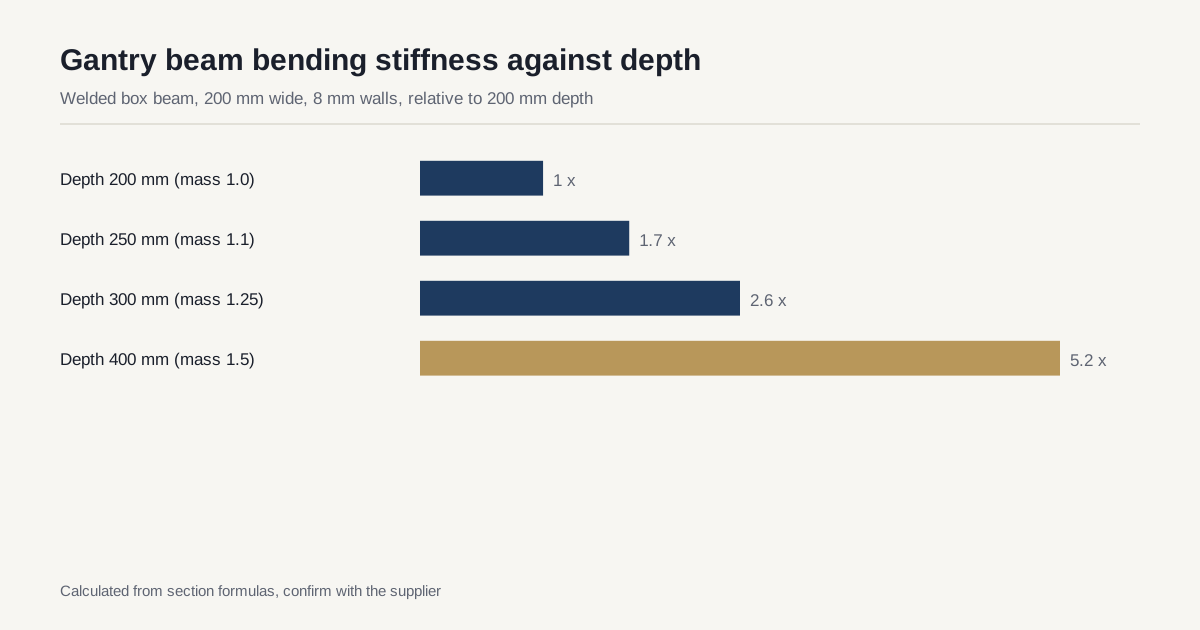
The cross beam is a long beam loaded at its middle by the weight of the spindle carriage and by cutting forces. Its bending stiffness depends on the second moment of area of its cross-section, which grows with the cube of depth.
That relationship makes depth the cheapest way to add stiffness. For a welded box beam 200 mm wide with 8 mm walls:
| Beam depth | Relative bending stiffness | Relative mass |
|---|---|---|
| 200 mm | 1.0 | 1.0 |
| 250 mm | 1.7 | 1.1 |
| 300 mm | 2.6 | 1.25 |
| 400 mm | 5.2 | 1.5 |
The values come from standard section formulas and are approximate. Making the beam twice as deep gives more than five times the bending stiffness for 50 percent more steel. Depth is limited by the clearance the machine needs over the table and by the height of the Z axis, so beam geometry is tied to the machine concept from the start. Internal diaphragms, evenly spaced, stop the thin walls from buckling or breathing and add torsional stiffness. See rib design for machine frames for the principles.
Beam bending is only part of the story. The measured stiffness at the tool is the sum of beam bending, leg bending, joint flexibility at the gantry corners, bearing preload and the carriage itself. Many routers deflect more at the legs and joints than in the beam. A good design gives each of these a share of a stiffness budget.
Racking and squareness
A gantry with a drive on only one side tends to rack, one side leading and the other lagging, as it accelerates. Dual-drive gantries with a motor on each leg avoid this but require synchronisation and good alignment between the two rails. The consequences of racking show up as non-square cuts: a rectangle becomes a parallelogram.
Frame requirements that follow:
- Rail parallelism. The two rails must be parallel to a tight tolerance over their full length, often 0.05 mm or better. They must also be level with each other.
- Rail straightness and flatness. Each rail seat is machined straight and flat to a few hundredths over a metre, as a minimum.
- Squareness of the gantry. The beam is square to the legs and the legs are parallel to each other, with machined seats for linear guides.
These tolerances are achieved by machining all the rail seats in one setup after welding and stress relief, as explained in machining large weldments. The measurement itself, including support condition and instruments, is covered in frame flatness and squareness checks.
Material being cut changes the design
Router frames are built for different applications and the loads differ.
- Wood and panel routing produces moderate cutting forces and high speeds. Gantry mass and acceleration dominate the design, and dust extraction affects layout.
- Plastic and composite cutting is similar to wood, with finer dust.
- Aluminium and non-ferrous cutting produces higher forces and calls for a stiffer, heavier structure and good chip evacuation.
- Stone, steel or hard materials need a milling machine design with a much heavier frame, not a light router frame.
A frame sized for wood will chatter on aluminium. State the target materials and depth of cut in the RFQ.
Stress relief and stability
The bed and gantry are welded structures, typically 3 to 4 metres long with plate in the 8 to 20 mm range. Stress relief before final machining prevents drift. Options include thermal stress relief in a furnace large enough for the part, and vibratory methods for oversize parts. The usual practice for stress relief is described in stress relieving welded machine bases.
Light frames made from tube or thin plate can distort during welding more than heavy ones. A planned weld sequence and good fixtures help. See welding fixtures for repeat production for how to make that repeatable.
Dust, debris and sealing
Routers throw dust and chips. Frames should not collect them. Sealed sections stop dust entering, and sloped surfaces and drain holes prevent build-up. If the machine uses an extraction table, the vacuum channels and sealing surfaces are part of the table’s design, not an afterthought.
Specifying the frame
A useful set of requirements for an RFQ:
- Table size, travel and maximum workpiece weight.
- Rail type, size and mounting dimensions.
- Flatness, straightness, parallelism and squareness tolerances, with datums.
- Material, plate thickness and delivery condition. Normalised plate helps with large machined faces.
- Stress relief requirement.
- Inspection method and report format.
- Paint or coating system, and shipping protection.
- Annual volume and whether the design is frozen.
Shops quote more consistently when the drawing separates machined faces from as-welded surfaces and gives a general tolerance for the rest, such as ISO 13920 or ISO 2768.
Thermal behaviour and accuracy
Router frames also change size with temperature. A long steel bed that warms by a few degrees grows by tenths of a millimetre, and a spindle that heats the gantry on one side can bend it slightly. Most routers accept this and compensate in the controller. Machines aimed at metal cutting or fine work keep the spindle and drive heat away from the structure, shield the frame from sunlight and allow warm-up cycles. If your machine will operate in a workshop without temperature control, state that in the specification, because it changes how much accuracy the frame can promise.
Sectional beds and long machines
Long routers and cutting tables, with a bed of five metres or more, are often built in sections bolted together. The joints between sections then become part of the stiffness budget and the straightness budget. Dowels and keyed faces keep the sections aligned, and a laser alignment at assembly sets the final rail line. Ask the supplier to machine mating faces in one setup and to test the sections assembled together before shipping. A bed that is straight in sections and kinked when assembled is a common and avoidable problem.
Checklist
- Choose beam depth first, since it adds stiffness for relatively little mass.
- Budget stiffness across beam, legs, joints and bearings.
- Machine all rail seats in one setup after stress relief.
- Specify rail parallelism and squareness with datums.
- State the materials to be cut so the frame is sized for the worst case.
- Plan sealing and drainage for dust and chips.
- Agree an inspection report that includes rail straightness and gantry squareness.
To receive comparable quotes for a gantry and bed, send the drawing with accuracy targets. The network replies within 24 business hours.
Have a frame drawing to price?
Send it through for a manufacturability review and a matched quote from the heavy-fabrication network. Reply within 24 business hours.