Welding consumables for machine frames: wire, flux and strength match
By Ryan, independent sourcing agent, Ho Chi Minh City, Vietnam
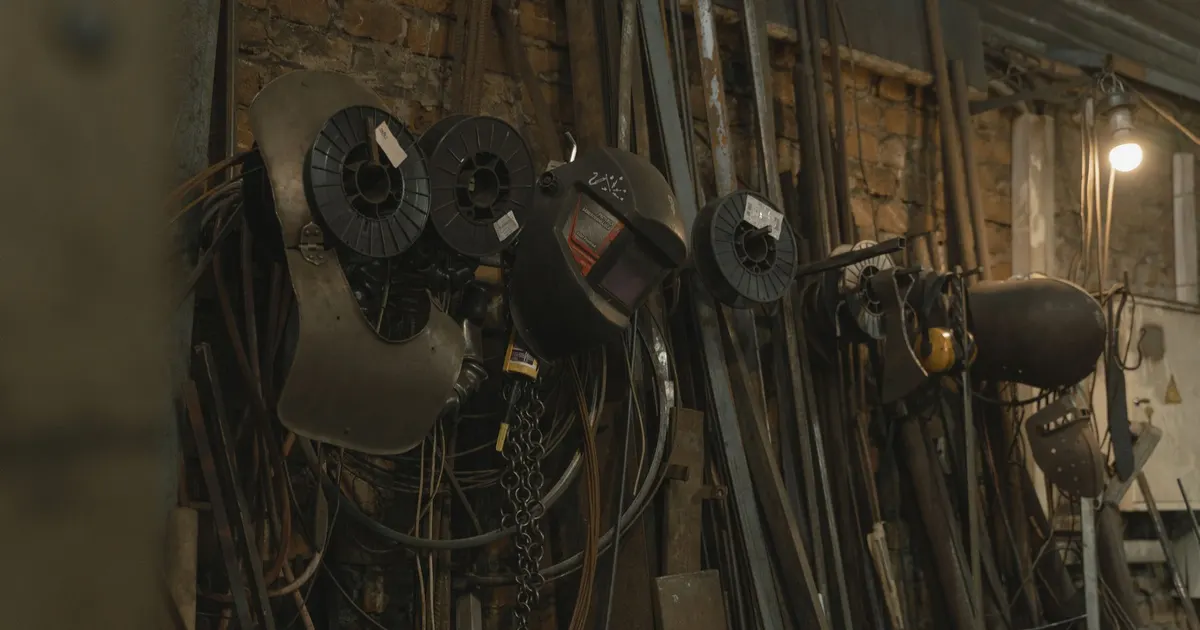
On most frame drawings the filler metal does not appear. The base material is named, the weld size is shown, perhaps a quality level is given, and the shop picks the wire. That is usually fine. It becomes a problem when the shop picks for convenience, not for the job: a wire on the shelf, a flux that has been open since last month or a strength that does not match the plate.
Consumables are a small share of the cost of a weld. Labour dominates. But they control the strength, toughness and cracking resistance of the joint. This article covers how consumables are matched to structural steel such as S355, what the common processes use, how hydrogen is managed and what to ask a partner shop.
Match strength to the base metal
The basic rule for structural steel is that the weld metal should have at least the strength of the base metal. For S355 plate with a minimum yield of about 355 MPa, that points to filler metal in the 420 to 460 MPa yield class, or in American terms a 70 ksi tensile class.
Designation systems state this differently:
- EN ISO 14341 for solid wire in gas-shielded welding uses a code such as G 42 2 M21 3Si1. The 42 refers to a minimum yield of 420 MPa, the 2 to the impact test temperature of -20 °C, M21 to the shielding gas group and 3Si1 to the wire composition.
- AWS A5.18 gives ER70S-6 for the same family of solid wire. The 70 refers to a tensile strength of 70 ksi, about 480 MPa.
- EN ISO 2560 and AWS A5.1 give E 42 4 B and E7018 for low-hydrogen electrodes.
Overmatching modestly is usual and acceptable. Heavily overmatching, using a high-strength wire on mild steel, makes the weld harder and less ductile than needed and can raise cracking risk. Undermatching can be acceptable for fillet welds sized for the lower strength, but it needs to be a design decision and not an accident.
The four processes in frame shops
| Process | Typical consumable | Standard | Typical use on frames | Deposition rate |
|---|---|---|---|---|
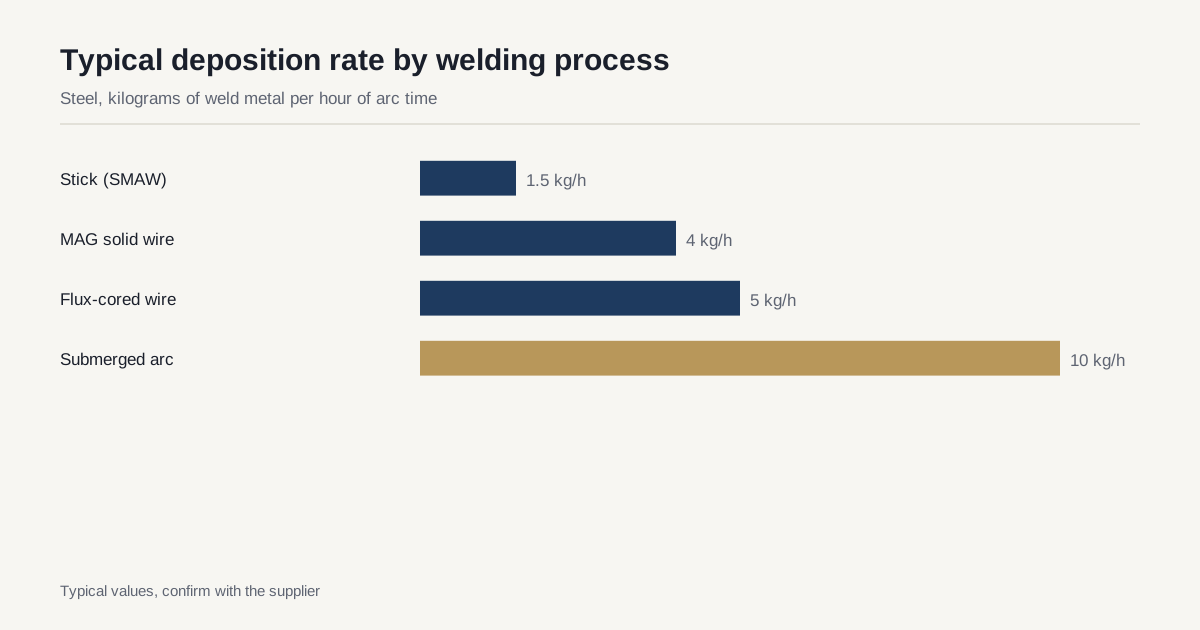
| Stick (SMAW) | Low-hydrogen electrode E7018, E 42 4 B | AWS A5.1, EN ISO 2560 | Repairs, site work, awkward positions | about 1 to 2 kg/h |
| MAG solid wire (GMAW) | ER70S-6, G 42 2 M21 3Si1 | AWS A5.18, EN ISO 14341 | General fabrication, most frame joints | about 3 to 5 kg/h |
| Flux-cored wire (FCAW) | E71T-1, T 42 2 P M21 1 H5 | AWS A5.20, EN ISO 17632 | Thick plate, out of position, high deposition | about 4 to 6 kg/h |
| Submerged arc (SAW) | Solid wire plus flux, S2 and flux | AWS A5.17, EN ISO 14171 | Long seams in thick plate | about 8 to 12 kg/h |
Deposition rates are typical figures. The real rate depends on current, wire diameter and position.
MAG welding with solid wire in an argon and carbon dioxide mixture is the workhorse. It is fast, clean and suits both manual and robotic welding. The mix, commonly about 80 percent argon and 20 percent CO₂ for steel, gives stable arc and good bead shape. Pure CO₂ gives deeper penetration with more spatter and is common in some markets.
Flux-cored wire deposits metal faster and tolerates mill scale and poor fit-up better. It is common for thick plate welded in the flat or horizontal position, and the slag helps hold the weld pool in other positions. The H5 on the designation shows a diffusible hydrogen level at or below 5 ml per 100 g of weld metal.
Submerged arc welding buries the arc under granular flux. It produces high-quality deep-penetration welds with very high deposition and little spatter, but it works only in the flat or horizontal position. Large frame sections with long straight seams are its natural territory, often welded on a positioner. The flux needs correct drying and handling.
Stick electrodes remain useful for repairs and positions that machines cannot reach. Low-hydrogen types need careful storage.
Hydrogen control
Hydrogen is the cause of delayed cracking in thick, restrained joints, as explained in weld preheat on thick frame sections. Consumables are one source of hydrogen, and their handling decides how much arrives in the weld.
- Low-hydrogen electrodes are baked in an oven at a temperature stated by the maker, often 350 to 400 °C, and kept in a holding oven at around 120 to 150 °C until used. A box left open on the bench absorbs moisture within hours.
- Flux for submerged arc is dried to the maker’s instruction and stored dry. Recovered flux is dried again before reuse.
- Flux-cored and solid wires are packed in sealed containers. Opened spools stay on the feeder under cover. Rusty or dirty wire should not be used.
- Joint preparation matters too. Oil, paint, rust and moisture on the plate near the weld add hydrogen. Cleaning the joint area is cheap protection.
Ask the shop how it stores electrodes and flux. Holding ovens, labelled containers and a log are visible signs of a controlled process.
Procedures tie it together
The wire is only one variable in a qualified welding procedure. The welding procedure specification, built from a qualification test under ISO 15614-1 or AWS D1.1, names the process, filler metal, shielding gas, current range, preheat and interpass temperature. Changing filler metal outside the qualified range requires re-qualification. Ask for the WPS reference for your joints and check that it names consumables to a standard. Welder qualification, covered in welding standards for machine frames, is a separate record.
Certificates for consumables
Consumable manufacturers can supply a certificate or test report for each batch of wire, flux or electrode, usually as EN 10204 type 3.1 or a manufacturer’s test certificate showing chemical composition and weld metal properties. For critical frames, ask the shop to keep the batch number of the consumable used on each job in the inspection file. It follows the same logic as plate certificates, described in mill certificate types.
Special cases
- Stainless to carbon steel joints need special fillers, commonly 309-type, to avoid cracking. Never use a plain carbon wire.
- Weathering steel needs a matching filler if appearance or corrosion resistance must match.
- Impact-tested joints, such as those in cold-service frames, need filler with impact values at the test temperature, for example the 2 or 4 in the EN code.
- Galvanised parts release zinc fume and need cleaned or ground joints; ask for the preparation method.
What to ask a partner shop
- What process and filler will you use for each joint type, and what is their standard designation?
- What is the WPS reference?
- How are electrodes and flux stored, dried and logged?
- Are consumable batch certificates available?
- If a different filler would reduce distortion or cost, what do you propose?
Gas, wire diameter and parameters
Wire choice is only part of the process. The shielding gas mixture changes arc stability, penetration and spatter, and wire diameter sets the current range and deposition. Thin wires of 0.8 to 1.0 mm suit thin sheet and out-of-position welding. Wires of 1.2 to 1.6 mm suit thicker plate and higher deposition. Larger diameters need higher current, which raises heat input. The welding procedure fixes these settings within a range, and the welder or robot works inside it. Ask whether the shop keeps a parameter sheet at the machine, which is a simple sign of controlled production.
Checklist
- Match filler strength to the base metal: 420 MPa class or 70 ksi for S355.
- Choose the process for the joint: MAG for general work, SAW for long thick seams, stick for repairs.
- Require low-hydrogen consumables and dry storage.
- Tie consumables to a qualified WPS.
- Ask for consumable batch numbers in the inspection file.
- Flag any special material combinations on the drawing.
To see how partner shops would plan welding processes and consumables for your frame, send the drawing. The network replies within 24 business hours.
Have a frame drawing to price?
Send it through for a manufacturability review and a matched quote from the heavy-fabrication network. Reply within 24 business hours.